
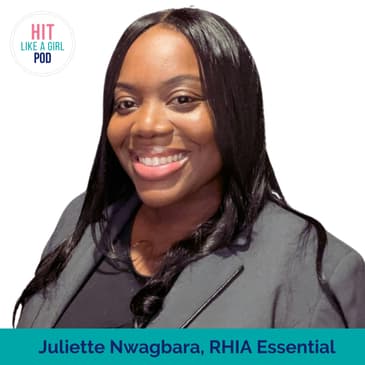

In this episode, Joy welcomes multifaceted health IT expert Juliette Nwagbara, who shares her journey and contributions to the field of health IT. Juliette wears numerous hats as a project manager at a health IT AI company, an instructor in health IT at UT Austin, and the founder of RHIA Essential, where she prepares future professionals for the RHIA certification. She discusses the significance of the RHIA certification, administered by AHIMA, which validates expertise in patient data governance, law, data standards, and project management. Juliette's mission is driven by her own challenges in finding support while studying for the RHIA exam, leading her to create resources that make learning engaging and accessible. She emphasizes the transformative power of health IT education in providing confidence, knowledge, and opening up diverse career paths for her students. Juliette's personal journey from discovering health IT amidst career uncertainty to becoming a passionate educator and advocate for the field underscores the impact of dedication and the desire to give back to the community.
[00:00:00] Hello, podcast listeners!
[00:00:03] Are you ready to advance your career in health care?
[00:00:06] Then join us at the Women in Medicine Summit, a two-day power-packed event designed to propel
[00:00:10] you forward.
[00:00:11] The HIT Like a Girl Pod crew will be there cheering you on at the Drake Hotel in Chicago,
[00:00:16] happening on September 13th and 14th.
[00:00:19] Get ready for skill-building workshops, inspiring talks, and actionable strategies
[00:00:23] to help you thrive in your health care journey.
[00:00:26] Here's the best part.
[00:00:28] Use code, referral5 at checkout to snag your ticket at a special discount.
[00:00:32] We can't wait to see you network, learn, and grow alongside other amazing women in medicine.
[00:00:38] Secure your spot now at womeninmedicine-summit.org and enter the code referral5 to unlock your
[00:00:44] exclusive discount.
[00:00:56] Hello there and welcome to the HIT Like a Girl Podcast.
[00:00:59] My name is Joy Rios.
[00:01:01] This is a show where we get to talk about how the complicated world of health care is,
[00:01:06] and I often liken it to a 30,000-piece puzzle where we're all trying to figure out what
[00:01:11] is the big picture.
[00:01:12] And each one of our guests brings an area of their expertise or a piece of the puzzle.
[00:01:17] So I am thrilled with who we have on today.
[00:01:20] I'm going to give her a moment to introduce herself.
[00:01:23] Juliette, please let us know all about you.
[00:01:25] Yes.
[00:01:26] Hi everyone.
[00:01:27] My name is Juliette Wombara.
[00:01:28] I wear many hats.
[00:01:30] So I am a project manager at a health IT AI company.
[00:01:37] Also teach project management in a health IT program at UT Austin, and I have my own
[00:01:43] baby, my own business, Rea Essential, where I do help train future health IT professionals
[00:01:50] to pass their Rea certification and a YouTube channel where I talk about health IT, hopefully
[00:01:56] to influence students.
[00:01:57] So, a lot of hats.
[00:01:59] A lot of hats.
[00:02:00] Can you tell us a little bit more about what makes you so impassioned and excited about
[00:02:05] Rea specifically?
[00:02:06] Because that is pretty incredible what you're doing, but how did you get there?
[00:02:11] Yeah, so I actually was studying to take my Rea.
[00:02:14] And for people who don't know what that is, we would think that they do, but
[00:02:17] like listeners that don't, what is that?
[00:02:20] Of course.
[00:02:21] So AHIMA has a, well AHIMA is an organization in health IT.
[00:02:24] AHIMA and then there's HIMS, they're like the two major players.
[00:02:28] So AHIMA has a certification.
[00:02:31] It's called the Rea certification.
[00:02:32] It stands for the registered health information administrator.
[00:02:36] And it's an exam that people can take in order to prove that they know the ins
[00:02:41] and outs when it comes to taking care of patient data governance.
[00:02:47] There's law.
[00:02:48] There's data standards.
[00:02:49] This project management is just a lot of information compiled in this
[00:02:54] exam.
[00:02:55] So you took that exam and then you wanted to teach others how they could succeed
[00:02:59] in taking that exam?
[00:03:01] Is that accurate?
[00:03:02] Correct, because I could not find anyone to help me when I was studying.
[00:03:06] I was like, wait, there has to be a way to help other people so they don't go
[00:03:08] through what I went through.
[00:03:11] And so I just did it and I've helped a lot of people and it's really fulfilling.
[00:03:16] OK, so tell me more about how you help them because I've seen your
[00:03:20] presence in the way that you are not shy at all in front of a camera,
[00:03:24] which I am a little bit jealous of, but in a good way.
[00:03:27] And I just like really wanted to, like, I guess get your perspective on how
[00:03:34] you show up for the people that are looking for the type of support that
[00:03:37] you didn't have.
[00:03:38] Learning can be boring.
[00:03:40] And so my thing is I try to make it as fun as possible and because
[00:03:45] it can get boring all the lingo and it's just it's not fun.
[00:03:48] So my thing is I want to educate you and help you understand
[00:03:52] the concepts and tell you what you really need to understand.
[00:03:56] And so how I do it, I used to do it on Zoom.
[00:03:58] So when I first started off, it was a Zoom every Saturday for six weeks.
[00:04:03] Come and sit there for two hours and listen to me talk on and on.
[00:04:07] But over time, I wanted to be just more organized with it.
[00:04:12] And so now it is an online prep course that people can take in order
[00:04:17] and do self-paced whenever they want.
[00:04:20] So that transition has helped me other people who couldn't make those Saturdays.
[00:04:26] That's kind of a big deal.
[00:04:27] So you're sort of becoming your own production company, right?
[00:04:30] Where you're creating content that's available on YouTube or elsewhere
[00:04:34] that's like on demand in support of their career goals.
[00:04:39] That's so cool, Juliette.
[00:04:41] Thank you.
[00:04:41] So when you started, can you talk about some of the challenges
[00:04:45] that have come up from that?
[00:04:47] Was that just easy for you to be like, all right, I'm going to,
[00:04:50] I am going to speak to an audience that I don't know exactly who they are
[00:04:53] and give them the support.
[00:04:55] And also, can you share with us who your audience is
[00:04:58] and who you feel most connected with?
[00:04:59] It was not easy.
[00:05:00] I was freaking out because I am comfortable, but it's like,
[00:05:05] I can't see who is watching me when you're on YouTube
[00:05:08] or when you're talking to someone on Zoom.
[00:05:11] Like it's kind of hard to see all these students.
[00:05:12] So I kind of went through a moment of just nervousness.
[00:05:16] And am I good enough?
[00:05:18] What am I doing?
[00:05:19] Do I know enough?
[00:05:20] But I had to listen to a lot of podcasts and a lot of just kind of self help
[00:05:25] things that kind of encourage me to push forward, that kind of get rid
[00:05:29] of that imposter syndrome because it definitely was present and say,
[00:05:33] hey, like I don't know everything, but I know enough to help someone else.
[00:05:38] And so I kind of had to remind myself of that
[00:05:41] and get encouragement from friends and family as I was doing it.
[00:05:45] And the more I did it, the more comfortable I got.
[00:05:47] And then who are you finding that you're helping?
[00:05:49] Like if you do have a case study or a student in mind that you're just like,
[00:05:52] oh, I made a difference for that person.
[00:05:54] I'd love to hear it.
[00:05:55] It kind of varies, right?
[00:05:56] I have students that are currently maybe seniors at their health IT programs
[00:06:02] and they know stuff, but they're not really getting what they need
[00:06:06] from their programs when it comes to taking that certification.
[00:06:09] And so they just want to be sure that they're ready.
[00:06:11] And then I have students that have been out of school for 10 or 15 years
[00:06:15] and they want to get that job.
[00:06:17] But the issue is that they have to get the certification.
[00:06:21] If not, they're going to lose their job or can I get that promotion?
[00:06:25] So I have a lot of different profiles when it comes to people that I help.
[00:06:31] But they all have the same issue.
[00:06:32] They need confidence, they need knowledge and what's going on for like for the exam.
[00:06:37] And I provide that to them.
[00:06:39] Is really the type of exam that somebody has to take multiple times,
[00:06:42] like an annual or is it on an annual basis?
[00:06:45] Or it's like a one and done type situation.
[00:06:47] It is a one and done.
[00:06:49] You do have to, of course, have your continuing education units,
[00:06:53] you know, like all certifications.
[00:06:54] But once you take it that one time, you are done with it.
[00:06:57] What I would like to know also is when you consider the one and done
[00:07:01] aspect of it, like what is it that it opens up?
[00:07:04] What are the opportunities that open up for people after they have taken
[00:07:09] and passed the exam?
[00:07:11] The possibilities are endless.
[00:07:13] And I always say it's what you make it.
[00:07:15] So some people may pass their RIA and then be able to apply for a job
[00:07:20] that they didn't qualify for, but they now do because they have their certification
[00:07:24] for other people studying for this exam opens them up to other sectors
[00:07:29] of health IT that they never thought that they even really enjoyed
[00:07:33] until they studied about it in my course.
[00:07:36] Some people end up doing my course and then want to become educators, right?
[00:07:40] So I've had a lot of different stories of what happened from that moment.
[00:07:45] So it varies. It really does vary.
[00:07:47] Can you tell me more about your personal journey
[00:07:49] because what happened for you after you finished it?
[00:07:52] Like you clearly are wearing a lot of hats.
[00:07:55] Do you like wearing that many hats?
[00:07:57] Do you want like if what do you see for your future one
[00:08:01] and three and five years from now as if I'm, you know, let's manifest?
[00:08:05] After I took my RIA, I was already working in the health IT field
[00:08:10] as a project manager slash implementation person.
[00:08:16] And so what it really did was it allowed me to really understand my clients
[00:08:22] better and really have just better conversation about what was going on at
[00:08:27] their facility. So that was really great.
[00:08:29] And then from taking the exam, it really just opened my mind up to,
[00:08:34] oh, like I don't have to be pigeonholed in this like little bubble.
[00:08:38] There's a lot of things that I really enjoyed and, you know, want to expand on.
[00:08:42] So it really just opened my mind to everything.
[00:08:45] And I know I wear a thousand hats is something that gives me pleasure.
[00:08:50] I always tell people like health IT kind of saved my life.
[00:08:53] I say that because I discovered health IT from just failure
[00:08:59] and from not really knowing what to do with my career.
[00:09:04] And once I discovered health IT, I just kind of fell in love.
[00:09:07] And so I just have this passion about giving back and doing all that I can.
[00:09:12] So my many hats are for a reason it's to I mean, the main reason is just to
[00:09:17] expose students to not only the opportunities available,
[00:09:22] but just pushing them to be the best professionals possible because we need them,
[00:09:26] especially with dealing with PHI.
[00:09:28] You need people that know how to handle it, but also just being able to help my
[00:09:32] clients and not just help them implement something or help them get something done,
[00:09:38] but actually fully understand where they're coming from and put myself in their shoes.
[00:09:43] You're doing a great service.
[00:09:45] Only one because workforce, right?
[00:09:47] Like there is this is health care supposedly a third.
[00:09:52] Of jobs in the US economy and there's especially clinicians and nurses.
[00:09:57] We're facing a lot of burnout, like the responsibility is significant
[00:10:01] and having qualified people to work in the industry is needed in a way that I
[00:10:06] don't think that we have ever known before.
[00:10:09] Like there's just so much to be done.
[00:10:12] But I love to know more about how you found it, right?
[00:10:16] Because I was I can say from a similar perspective,
[00:10:19] I didn't know that health care or health IT is where that I where I was going to
[00:10:23] land career wise.
[00:10:24] But once I found it, I was like, oh, this isn't my place.
[00:10:27] But how did you how did you find it?
[00:10:29] Funny story, how I discovered health IT was I was actually a podiatry
[00:10:36] student at a college or medical school, podiatry school in Ohio.
[00:10:42] And I was there, but I was mentally not there.
[00:10:46] I did not enjoy anything that I was learning, but I just really wanted that title.
[00:10:52] And one day in class, the teacher that I had mentioned that, hey, you know,
[00:10:57] by the way, guys, health IT is this new thing and there's going to be a lot
[00:11:00] of technology and things going on.
[00:11:02] So as future podiatrists, just make sure that you are aware of this
[00:11:07] and she was done.
[00:11:08] But everyone wrote it down.
[00:11:10] They left it.
[00:11:11] But for me, I was like, wait a minute, what is health IT?
[00:11:15] And so from that moment, I just started to research and dig into exactly
[00:11:20] what it was. And the more I looked into it, the more I wanted to do it.
[00:11:25] I just kind of started trying to find programs.
[00:11:27] And from there, it led me to, you know, this is what I should be doing.
[00:11:32] Like this interest that I have should be what your career should feel like
[00:11:37] something that you enjoy doing.
[00:11:38] And I truly enjoy health IT and all of its benefits.
[00:11:42] Now, do you find yourself ever in a clinic setting or patient facing?
[00:11:46] Or is your work like 100 percent kind of behind a computer or in an office setting?
[00:11:52] I am more so behind the scenes helping the actual organizations.
[00:11:57] However, there are moments where I may have to go travel and go to a facility
[00:12:02] and then kind of see firsthand the impact of the technology, which I love
[00:12:07] doing that for a lot of years, especially in past jobs, a lot of travel,
[00:12:11] a lot of patients and doctors and all that.
[00:12:14] So I've seen both worlds.
[00:12:16] I like both. Yeah, I'd love also to know if you're interested in sharing
[00:12:20] some of the impact that you have seen that health IT has in a clinic setting.
[00:12:26] Right? Like sometimes we can feel so far away from the work that we're doing.
[00:12:30] And you realize, oh, no, I'm actually making a difference.
[00:12:32] Do you have examples of that?
[00:12:34] Oh, of course.
[00:12:35] The first thing that popped in my head as soon as you said that this
[00:12:38] was from a job probably in 2015, 2016.
[00:12:42] I was in Florida implementing a hospital.
[00:12:46] They had about, I want to say, like 35 locations.
[00:12:49] It was like this huge entity.
[00:12:52] And so I was I was at one clinic and there was a medical assistant
[00:12:56] and her job was to check people in and get them ready.
[00:13:00] But she was flustered because it's so many people coming in and out.
[00:13:05] And like you can see the stress on her face.
[00:13:08] And so I was there to, you know, finalize implementation, get her
[00:13:12] like kind of get them live.
[00:13:14] And after showing her, hey, this is what you're going to be doing.
[00:13:17] This is a iPad and you're just going to hand them the iPad.
[00:13:20] They're going to do all this for you.
[00:13:22] And then you can just sit back, look at your computer, check them in
[00:13:25] and just focus on other things.
[00:13:27] Once she got the hang of that by like day three or four,
[00:13:31] like she wanted to hug all of us because the weight that was on her
[00:13:36] shoulders to manage the office was off.
[00:13:40] And remember that, like she's the starting point, right?
[00:13:43] She's the person that has to ensure that everybody gets their care.
[00:13:47] So if she doesn't do her job well, the nurse can't do their job.
[00:13:51] The doctor can, you know, can I do their job well?
[00:13:53] So it was a lot of pressure.
[00:13:55] And I just saw her feel, I just physically saw that release.
[00:13:59] And I said, yeah, this is this is powerful.
[00:14:01] Yeah, I feel like we kind of have a responsibility to do our best to make
[00:14:05] their jobs as easily doable as possible so that they can focus on the things
[00:14:11] that really matter, you know, that like what did they say?
[00:14:14] Like higher to the top of their ability.
[00:14:17] Exactly. Yeah.
[00:14:18] And basically like intake, you know, we can make that easier.
[00:14:21] Yes, we can help you check these people in and you can focus on other things.
[00:14:26] So there's so much to do in a medical facility, so much.
[00:14:29] When I think about like your students and the people that are coming to you,
[00:14:34] is it only through YouTube?
[00:14:36] Did you say you have online and on demand courses?
[00:14:39] Do people have an opportunity to spend time with you live one on one?
[00:14:43] Or is that not part of your model?
[00:14:44] I have currently because right now for those that are RIA
[00:14:49] takers past present, they know that right now RIA is going through a beta phase.
[00:14:55] And so the exam has changed a little bit.
[00:14:57] So my course is currently being worked on and improved to meet those changes.
[00:15:01] But in the past, the way that it worked is I have a YouTube platform, RIA essential.
[00:15:08] If you're studying for your RIA and you just don't want to pay me to educate
[00:15:12] you on anything, you can check out the platform.
[00:15:15] I talk about the exam and I also talk about just RIA or just health IT
[00:15:19] careers just in general, right?
[00:15:21] So it's all for students.
[00:15:23] But for those that do want to pay, I did have a standard plan and a premium plan.
[00:15:28] And so the premium students were able to have one on one with me
[00:15:33] and I would do things for them on the side.
[00:15:36] So that was kind of my model at that moment.
[00:15:40] I am making changes as we speak.
[00:15:42] And then I do also do event bright things where I have like game
[00:15:47] like RIA game nights and just some fun stuff.
[00:15:51] I love it.
[00:15:52] Yeah.
[00:15:52] Like how do you how what are the other ways that you make it fun?
[00:15:55] So I mean, a RIA game night.
[00:15:56] What would that involved and how can I sign up?
[00:15:58] Yeah, so that was Kahoot.
[00:16:00] And I did give out some gift cards for those that, you know, did well.
[00:16:04] We had a pretty good turnout and people just learned from each other.
[00:16:08] And it was just a good time just to learn and have fun.
[00:16:11] I love that.
[00:16:12] I just I love that model.
[00:16:13] And I think that you're right about when learning about how you're going
[00:16:16] to make a difference that it's got to be fun.
[00:16:18] It's got to be engaging.
[00:16:20] People actually want to be there and want to learn more and hopefully
[00:16:24] learn from each other.
[00:16:25] You had mentioned a minute ago about the different health IT careers.
[00:16:29] And I went, if you have a list of those, do you think that you can like
[00:16:34] state state them so that listeners could know?
[00:16:37] Like, listen, these are the possibilities of what is available to you
[00:16:41] career wise and because it's not just, I think nurse informatics
[00:16:46] or, you know, particular types of doctors.
[00:16:49] So let's hear those job titles.
[00:16:51] Well, there are a lot of them.
[00:16:53] If it goes to a Hema, they have the career map.
[00:16:56] If you go to Hems, they have a packet.
[00:17:00] I give my students that UT access to both.
[00:17:03] If I there's so many, I probably couldn't name all of them.
[00:17:06] I can name a few.
[00:17:07] Let's hear it.
[00:17:07] Product manager, of course, project manager, data analyst.
[00:17:12] You can be a like a legal legal analyst.
[00:17:17] I will call it an analyst, but like someone that is focused on helping
[00:17:20] the institution when it comes to like the legalities of health IT
[00:17:24] privacy officer.
[00:17:26] You have your medical coders.
[00:17:28] You have your chief or not even chief, but just nursing informatics
[00:17:32] professionals.
[00:17:33] You have your cancer registry people.
[00:17:35] They're always forgotten, but they are part of our community.
[00:17:39] There's so, so many cancer.
[00:17:41] Reds so basically registries for any type of cancer or just generic
[00:17:45] cancer registry, like all cancers.
[00:17:47] Well, cancer registry, it will depend on the location, but they are there
[00:17:51] to kind of help report and keep track of the actual cancers that
[00:17:56] someone may or may not have, and they will report it over to the
[00:18:00] agencies and stuff like that.
[00:18:02] So, but there are other registries out there outside of just cancer
[00:18:06] registries. There's immunization registries,
[00:18:08] yeah, syndromic surveillance, so many diseases.
[00:18:12] So much.
[00:18:13] So all of that is involved.
[00:18:15] You have your people that work the front desk, they may not have
[00:18:20] got master's degrees, but they still are a part of the health
[00:18:24] IT family. So yeah, ranges.
[00:18:27] There's so many.
[00:18:27] And then there's doctors who actually study informatics and
[00:18:31] they decide to go ahead and do that.
[00:18:33] And to add to that, educators, you may not work in the field.
[00:18:37] Exactly.
[00:18:38] But if you're educating people about health IT, you are a part of
[00:18:43] the community. You are helping to push it forward.
[00:18:45] I think a lot about patient education or and just not just
[00:18:50] patient specific education, but even medical literacy and
[00:18:53] like literacy in general is an area that we would like
[00:18:57] everybody to be, you know, to level up in so that we can
[00:19:01] have leveled up conversations.
[00:19:03] But wow, is that hard?
[00:19:05] And conversations I've had with folks have been like, well,
[00:19:07] whose responsibility is it to provide that level of education?
[00:19:12] And it's, it's all of us.
[00:19:13] The answer is everybody.
[00:19:15] It's not a single entity.
[00:19:17] And so it takes people stepping up and being like, I'm going
[00:19:21] to be part of this solution.
[00:19:22] And I just have so much respect for what you do and applaud
[00:19:26] that you just literally are doing it.
[00:19:28] Like there's a lot of people that come with that fear of
[00:19:32] like, oh, should I do something or should I like
[00:19:34] you see something that needs to be done and you've
[00:19:36] just decided to do it?
[00:19:38] And I will share with our listeners how we met, if you don't mind.
[00:19:41] You know, of course.
[00:19:42] So we had an event in Washington, DC, and I'm not exactly
[00:19:46] sure how you found out about it, but you are based out of
[00:19:49] Texas and literally like shared that you had flown all the
[00:19:53] way to DC to be there for our networking event.
[00:19:56] And I was just so floored by your like get up and go
[00:20:00] this right that I was like, I honestly was honored to
[00:20:04] be in your presence that day and felt like just so, I don't
[00:20:08] know, proud that we were creating something that was
[00:20:12] enough of a pull for you to make an effort, that level
[00:20:16] of effort to be there.
[00:20:17] And then to find out what it is that you're doing.
[00:20:20] I was just like, this woman is impressive.
[00:20:23] I was like hands down all kudos to you.
[00:20:26] Yeah.
[00:20:26] And thank you because I actually just to share how
[00:20:29] how did I get there?
[00:20:30] So I actually already knew about you from just social media.
[00:20:35] I'm like, wow, who's this person like empowering women, you
[00:20:38] know, in health IT because it's such a man man world and just
[00:20:44] just want to push those barriers aside.
[00:20:46] So that excited me.
[00:20:47] And then I actually connected with one of your partners.
[00:20:52] And from there, she was like, Hey, are you going to be
[00:20:54] in DC?
[00:20:55] And I'm like, well, no, but I can be like, sure.
[00:20:58] I just I just love networking with people that really have a
[00:21:01] passion for health IT.
[00:21:03] And I just see that in your organization.
[00:21:06] So I just I had to be there, you know, I had to be there.
[00:21:09] That means and meant a lot to me at the time.
[00:21:11] And I think about the passion that we have and it's not
[00:21:13] just for health care.
[00:21:14] It's not just for technology.
[00:21:16] Like encompasses policy and of course, a leveling up of women
[00:21:20] in the industry and gender expansive people and beyond.
[00:21:23] But just sort of there's so much work to be done.
[00:21:26] I think that I am similar to you in the sense of just like, oh,
[00:21:30] how can I help?
[00:21:32] But essentially, that's where it comes from.
[00:21:34] There's so much that needs to be done.
[00:21:35] You can't necessarily wait for somebody to tell you what to do.
[00:21:38] Like, you just got to see it and find the problem that you want
[00:21:43] to solve and just go after it.
[00:21:45] So I'm thinking what are the best ways that we can support you?
[00:21:49] Like what would be a great level of support?
[00:21:52] Would it be followers?
[00:21:54] Is it listeners?
[00:21:55] Is it attendees?
[00:21:56] You know, tell me.
[00:21:57] My biggest passion, aside from everything that I do,
[00:22:01] my biggest passion is educating students and exposing them to health IT.
[00:22:06] And I try to do that on my YouTube channel.
[00:22:09] So getting people that will either talk to me about what they do
[00:22:14] for their careers or just telling students about the platform would be amazing.
[00:22:20] I definitely have dreams of making it a whole lot bigger than what it is
[00:22:24] right now, aside from YouTube.
[00:22:26] But that would be like the biggest thing.
[00:22:28] If you are a speaker or some type of professional in health IT and you do
[00:22:33] something every day that maybe someone is wondering about, reach out.
[00:22:38] Let me know.
[00:22:38] Hey, I would love to be on your health IT playground show.
[00:22:43] And I'll definitely love to talk to you.
[00:22:44] I just want to educate students.
[00:22:46] That's it.
[00:22:46] And it sounds like you would be bringing them inspiration,
[00:22:49] something to be inspired by.
[00:22:50] Exactly.
[00:22:51] I love that.
[00:22:52] Will you mind sharing with me your big dream?
[00:22:54] What's your like, you know, in the future, what do you anticipate if it grows
[00:22:59] beyond YouTube?
[00:23:00] Like, what are your wildest dreams of success look like?
[00:23:03] The reason I ask is because sometimes I feel like, you know,
[00:23:06] include myself in this is that I don't dream big enough.
[00:23:09] My biggest dream is to build a community of just health IT students.
[00:23:14] Just because I feel like we are so siloed.
[00:23:17] Everyone's at their schools.
[00:23:18] Everyone is in their corner.
[00:23:20] It's maybe like maybe four or five people in the health IT program,
[00:23:24] but just having a place of having a community where it's people that past
[00:23:30] present are health IT professionals that can come together of all walks
[00:23:35] of life and just learn and grow with each other.
[00:23:37] That's beautiful.
[00:23:38] Oh, Juliet, thank you for spending this time with me.
[00:23:41] Thank you for the work that you do.
[00:23:43] Thank you for your vision and thank you just in general.
[00:23:46] You are a good human doing good work out in the world.
[00:23:49] So I'm I'm glad to know you need to.
[00:23:51] You are doing amazing stuff too.
[00:23:53] Just FYI.
[00:23:56] Well, thank you for spending this time with me.
[00:23:58] Right. Thank you.
[00:23:59] One last thing, Juliet, if people want to follow you or work with you,
[00:24:03] where would you direct them?
[00:24:04] If you want to work with me, I would go to or rather contact my email
[00:24:09] or contact me at my email rather.
[00:24:12] It's Ria ready, R-H-I-A-R-E-A-D-Y at Gmail.com and just shoot me a message.
[00:24:20] And I will definitely get back to you as far as just being a follower,
[00:24:25] subscribing to the YouTube channel will be great.
[00:24:27] And if you type in the word Ria essential, R-H-I-A space essential,
[00:24:33] then you'll find me.
[00:24:35] There's only one Ria essential.
[00:24:36] That's me.
[00:24:36] So please subscribe and share with those that are thinking or already a part of the health IT field.
[00:24:43] You got it.
[00:24:44] Count yourself at least one new subscriber today.
[00:24:48] Thank you.
[00:24:48] Yeah, my pleasure.
[00:24:50] Thanks for listening.
[00:24:51] You can learn more about us or this guest by going to our website
[00:24:55] or visiting us on any of the socials with the handle hit like a girl pod.
[00:24:59] Thanks again.
[00:25:00] See you soon.
[00:25:01] Again, thank you so much for listening to the hit like a girl podcast.
[00:25:05] I am truly grateful for you and I'm wondering if you could do me a quick favor.
[00:25:09] Would you be willing to follow or subscribe to this podcast
[00:25:12] or maybe leave us a rating or review?
[00:25:14] Or if you're feeling extra generous, would you share this episode
[00:25:17] on your Instagram stories or with a friend?
[00:25:19] All of those things help us podcasters out so much.
[00:25:23] I'm the show's host Joy Rios and I'll see you next time.