
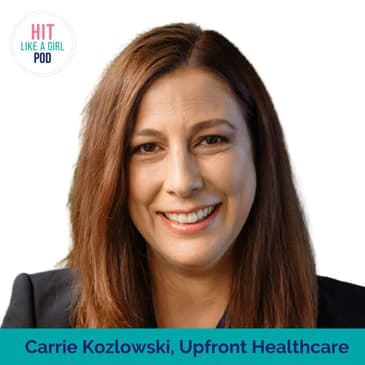

In this episode, Joy delves into the complexities of healthcare with Carrie Kozlowski, co-founder and COO of Upfront Healthcare. Carrie discusses Upfront's mission to guide patients to the care they need, addressing barriers to access and striving to transform healthcare. Emphasizing personalized engagement and leveraging technology as a conduit, they explore how to empower patients and remove friction from the healthcare process. Through insights into psychographics and behavioral science, they reveal strategies to motivate patients and foster trust, ultimately aiming to enhance outcomes and promote population health.
[00:00:00] Hey there HIT Like a Girl Pod listeners, we've got some exciting news that's too good to keep
[00:00:05] to ourselves. You all know Grace Minton, whose stories have captivated us over the past couple
[00:00:10] years. Well, Grace has been doing such an amazing job with her show High Tea with Grace that it's
[00:00:16] time for her to shine even brighter. Yes, you heard that right, High Tea with Grace has
[00:00:20] graduated to its own show with its own brand new RSS feed. While we've loved sharing Grace's
[00:00:27] episodes as special bonuses on the HIT Like a Girl Pod, it's now time to give Grace the
[00:00:32] spotlight she deserves. So what does that mean for you? To continue enjoying the compelling
[00:00:38] stories and insights from Grace, head over to your favorite podcast platform and hit that
[00:00:42] subscribe button for High Tea with Grace. Trust us, you don't want to miss out on what she has in
[00:00:48] store. Her latest series is dedicated to understanding the VC funding world, aka fund
[00:00:54] Like a Girl. Thank you for supporting us and let's show some love for Grace on her exciting new
[00:00:59] journey. Remember, search for High Tea with Grace and subscribe today.
[00:01:11] Hey there and welcome to the HIT Like a Girl podcast. My name is Joy Rios. On the show, we talk about how complicated healthcare can be. It is the 30,000
[00:01:29] piece, the 300,000 piece puzzle that we're all trying to solve and every one of our guests comes in with their level of expertise
[00:01:37] and helps us try to make sense of the big picture. Kari, can you take a moment to introduce yourself?
[00:01:42] Sure. Thanks for having me. My name is Kari Koslowski. I'm the co-founder and CEO at Upfront Healthcare. Upfront's focused on guiding every patient to get the care they need.
[00:01:50] And really everything we do is about our mission and how we can hopefully help transform healthcare so that more patients get care
[00:01:56] and we overcome some of the equity and social barriers and overall move outcomes in population health in the right direction.
[00:02:03] Okay, all of that sounds amazing. How do we actually do that? What does it look like?
[00:02:07] Fixing healthcare. Yeah.
[00:02:11] It's fun. I think you're asking a really good question and I think it's an interesting question to ask at a big tech conference, right?
[00:02:17] Because I don't know that technology is the answer to fixing healthcare. I agree.
[00:02:21] It's a conduit to fixing healthcare. I think what I love in our work and I love working with our clients is getting with all the people who
[00:02:29] have healthcare experience 20 years, 25 years. Most people that we get to work with are at that stage of
[00:02:35] and I've been doing this for a while. I've made some mistakes. I've had some success and I have like
[00:02:40] I want to just have this one more impact. I got this mission. I have this idea. I have this vision.
[00:02:46] Those are the folks that I think are going to be able to move the needle on healthcare and when we can bring them together
[00:02:50] through networking, through partnership summits, all those kinds of activities.
[00:02:54] That's how I think we're ultimately going to fix healthcare. It's multiple voices getting outside the four walls of
[00:03:00] whether they're a health system or a vendor and urgent care and like getting into the meat of what are our biggest challenges.
[00:03:05] And what gets to be the meat of what you get to do? I know you get to deal with a lot of data,
[00:03:10] but if we're talking about access and solutions for the patients, what does that exactly look like?
[00:03:15] What we do specifically is we try to empower the patient to be able to take action and we try to remove friction from the process for them to do that.
[00:03:22] What that really means is we engage patients using omnichannel technology, but in a hyper-personalized way.
[00:03:29] So everything we do is thinking about what are the barriers this patient is facing?
[00:03:33] What's relevant for this patient? When's the right time to outreach to them? I want to engage them,
[00:03:37] but I want to engage them in a moment that matters so we can capture some mind share.
[00:03:41] And so all of that ultimately though is in this opportunity to guide them to get that care.
[00:03:46] And I think where we fit in working with all of our clients is part of their transformation
[00:03:52] and part of how do we really activate patients to be members instead of saying,
[00:03:56] oh it's patient-centric, oh patients are empowered. How do we put the information in their hands
[00:04:01] at a moment that they're likely to take action and give them all of the answers to their questions so they don't have any reason not to?
[00:04:07] Where are those meaningful moments? How do you do that? Is it a text message right when somebody
[00:04:12] is at the right time? Like how does that work? The answer is it depends, right? It depends on the person.
[00:04:17] And so one of the things we try to do is understand what people's motivations are. We apply psychographics,
[00:04:23] we built a psychographics for healthcare model. It's the only one that exists and it really
[00:04:27] understands what influence and motivates decisions that people make around their healthcare.
[00:04:32] That's one thing, but we also think about relevancy. So we think about a campaign-based
[00:04:37] approach. If you tell me it's October, Carrie, it's Breast Cancer Awareness Month. You should get your mammogram.
[00:04:42] What you're telling me is you know that I'm a woman and you know it's October.
[00:04:46] And you probably know how old I am roughly, right? But what if we could tell people, which is what we do,
[00:04:51] hey it's been 11 months since your last mammogram. Getting this care is important.
[00:04:56] Here's why it's important and here's where you can get it, where you had it scheduled last time.
[00:04:59] Let's get you scheduled now and you don't have to wait on the phone if you don't want to,
[00:05:03] right? You can just take all of that friction and make it really easy. Then I feel like you're
[00:05:07] actually easing my way on the path to continuing to partake in my preventive care versus marketing to
[00:05:14] me, which can feel insincere sometimes and not necessarily a way that builds my trust.
[00:05:19] So can we talk about the psychographics and building trust? Like I would love to geek out
[00:05:23] on that. Yeah it is geeked out on and I am not the deepest person on this because we have a
[00:05:28] ton of really smart data science, consumer science, behavior science people at up front
[00:05:32] who think about this all the time. But I think it's fascinating is we think about this from
[00:05:36] the most proactive person who engages in their care. They're called the self-achiever. This is the person
[00:05:41] who attacks their goals, won't be competitive against their goals, is just going to win when it
[00:05:48] comes to the health care. All the way through we think about the more reactive is the willful
[00:05:53] endure. This is the person who will, you know, it's not hurting that bad. It's fine. Preventive
[00:06:00] care is sort of lost because it's not super convenient and that feels so far away when
[00:06:04] something might happen. And so they have really different ways in which they engage with health
[00:06:09] care and then we have everything in between. So a self-achiever, let's attack your goals,
[00:06:12] let's get after it versus a willful endure. Hey let's make it really convenient. These are the
[00:06:17] folks 60% of urgent care visits or 60 something percent of urgent care visits are done by willful
[00:06:22] endures. Is there a way to self assess because I feel like there's times that I've been
[00:06:25] proactive and I'm like oh I've definitely been a willful endure. Like I didn't see and go get
[00:06:31] any help from my back pain until I couldn't move it at all. And I'm like me? Why did I do that?
[00:06:36] There's a classifier test quiz on our website that you can take up fronthealthcare.com. You
[00:06:42] can find it there and it is really fun to take and kind of see how it reflects back at you.
[00:06:46] Nobody is 100% of anyone element though so it'll kind of give you your primary approach but
[00:06:52] you might be 60% of us a willful endure and 40% of a balance seeker. The thing and the
[00:06:58] other piece of it that's interesting to me also is how we speak to people because in healthcare
[00:07:03] most marketing and you think about pharma marketing, it really is about doctor says,
[00:07:08] doctor knows best. Only about 17% of the population believes their doctor knows best.
[00:07:14] And so when we market that way we're really off putting many people. For example there's a group
[00:07:19] of people we call balance seekers. That's when I am who want the evidence. Show me the
[00:07:23] evidence, give me the research. Okay I can make this decision because everything is telling
[00:07:26] me that's the right thing to do and I'm well informed now to take that. So this is where
[00:07:31] all of it fits together in a really unique way to kind of speak. Hey Carrie let's attack that goal
[00:07:35] and get your mammogram. Hey Carrie we can get your mammogram with the location down the street
[00:07:39] in the next two days. Let's get you scheduled. Like those kind of things. So when I think about
[00:07:43] why I took so long I'm like oh I'm going to make an appointment and my appointment's
[00:07:47] probably not going to be for two or three months from now because I have to get a referral.
[00:07:50] So I've got to go through a telehealth appointment to then get a referral. It's
[00:07:54] going to be three months and what if my back doesn't hurt in three months when I the day of
[00:07:58] my appointment or in the same way or something. I'm like how do I express that my pain level
[00:08:03] or whatever it is that I'm experiencing today right now because it's awful, feels terrible but then
[00:08:08] the time in between right? Then I'm like well maybe you'll just get better. You might be a
[00:08:13] waffle under our feet. Sounds like that. I think in all of those cases what we really
[00:08:19] want to focus on is the patient and we don't want to limit to the psychographics. That's
[00:08:23] the other piece that's important because how we initially motivate you and speak to you.
[00:08:27] But we've also got to have technology that allows you to easily make appointments,
[00:08:31] easily understand care and we need to think about how we nudge you on that journey right?
[00:08:35] What is the behavior science around how you are likely to accept information? How many times
[00:08:41] can we help you remind you before you want to opt out? How do we find that sweet spot
[00:08:45] where we can kind of using behavioral science and psychographics help patients?
[00:08:49] I appreciate the idea of like oh you can we can get you in in two days. I'm like oh that's
[00:08:55] quantitative I'm happy about that like I will make a move because I can schedule it into my week
[00:09:00] right now. It's not like off in the distant future some random time but who knows I might be in
[00:09:05] Chicago that week. I hope so. Yeah I think this is where the access challenge comes in. When we
[00:09:11] initially started thinking about what we wanted to build in our patient engagement platform
[00:09:16] I personally had maybe advice for this concept of okay well what we should be looking at is what
[00:09:20] type of visit and what kind of sickness does a patient have and maybe if you have an ear infection
[00:09:25] you should go to urgent care and if you have diabetes you should see your primary care physician.
[00:09:30] But the reality is it's not about disease or visit type it is about each individual person
[00:09:35] and if you get your A1C on time regularly at the urgent care then you should do that
[00:09:41] and if you really need to see your physician when you have an ear infection because
[00:09:45] that's how your continuity of care and that's the value you place on your loyalty
[00:09:49] then you should do that. So this has been a really interesting and enlightening journey for me to
[00:09:54] learn about how people make decisions and how we can look through a different lens essentially
[00:09:58] to help solve this challenge. I'm curious because the psychographic part is actually from what
[00:10:03] I understand a relatively new part of your business right so how did that get involved
[00:10:08] from what I understand there was an acquisition yes like okay first of all just as an
[00:10:12] entrepreneur I'm just like how was that journey because on the business side not even the health
[00:10:18] or technology side like that's a whole other nut to crack. Yes, yes. I think you know when we think
[00:10:25] about growing our business over the years and we're fortunate to have a number of really strategic
[00:10:30] healthcare investors and so we've a really strong group of advisors board members and senior
[00:10:34] leadership who have been in healthcare for 20-25 years so we have really great networks.
[00:10:39] What that means is that over the years we are building relationships with folks who are doing
[00:10:43] other really cool things to help patients and over time you start to find people who are mission
[00:10:48] aligned to you who are maybe approaching it in a slightly different way and you figure out
[00:10:53] what's complementary. I think it's really important in entrepreneurship to not approach
[00:10:58] everyone as a competitor and to kind of take a little bit more of an open mind and a broader
[00:11:02] lens to how you see the universe and I think that's really where this opportunity came up
[00:11:07] we acquired a company patient bond about 15 months ago but we've known them for five, six,
[00:11:12] seven years and have been talking to them all along the journey about our respective approaches
[00:11:16] to what we were doing. And did it feel like you guys were competing with one another? Were
[00:11:20] you trying to solve the same problems? I think we were trying to solve similar problems which
[00:11:24] is to help patients get care. Their approach was very psychographic driven our approach was
[00:11:28] very behavioral science driven we can skip the chocolate and peanut butter analogy here
[00:11:32] but what was interesting is we were also approaching it in different market segments
[00:11:36] and so that's really what also made it interesting from a business perspective
[00:11:40] for us is to be able to think more upstream. Anything about guiding every patient to get
[00:11:44] care like our work have historically been primarily with health systems and large medical
[00:11:48] groups their work primarily in big urgent care as well as vendors who do care management
[00:11:53] and specialty pharmacy and so now we're really working with the continuum of care
[00:11:59] which is also as an entrepreneur and someone thinking about product strategy all the time
[00:12:03] super fun because they get so much more direct input from people living in this every single day
[00:12:09] to think about what does our product need to do and how do we need to continually evolve it.
[00:12:14] So one of the conversations that even has just been showing up today is about receiving
[00:12:18] feedback and also receiving negative feedback right of just like what is not working what are
[00:12:22] the challenges and how does that show up for you? Is it something that you get excited
[00:12:27] about or feel threatened by? It's a great question so I had the experience of the last company that
[00:12:34] Ben started he's my co-founder right up front when that company was ultimately acquired went to the
[00:12:39] advisory board and at the advisory board one of their core values was running to criticism
[00:12:44] and that was a little bit hard for me to learn you know 10 15 years ago kind of how do you
[00:12:48] kind of approach feedback in this way it was such a great experience is it really pivoted
[00:12:53] my way of thinking about feedback is from a place of curiosity versus a place of defensiveness
[00:12:58] and so I think that has been a huge part of how we try to approach feedback now we have
[00:13:03] a core value called continuous improvement and that really encompasses the idea that
[00:13:07] feedback is how we continue to get better and understand what the market needs.
[00:13:10] And does that happen just on an external basis or also internal to have dialogues
[00:13:16] internally as well? Internally it's on process right people in process and how can we help our
[00:13:22] teams work efficiently how can they feel more supported what can we learn from them?
[00:13:26] As we've grown the company you're further and further from the day to day pieces of what it
[00:13:30] takes to implement a client or code a new piece of product or you know decide what we do next
[00:13:35] and so I think that part is really great from the team's perspective and then obviously we're
[00:13:40] always looking to hear from our clients and drive that feedback and we have partnerships
[00:13:44] like class who helps give us that feedback and who help give us that feedback on a regular
[00:13:49] basis too. Okay so I'm going to shift gears and just thinking about you as an amazing woman leader
[00:13:56] for somebody who if you consider yourself as like we've gone down a path that other people can follow
[00:14:01] the generic advice question but really if somebody is trying to follow in your footsteps like what
[00:14:06] lesson have you learned over your career that they might be able to hopscotch right like guess
[00:14:12] what I had a problem you could skip it. The advice I guess I would give in terms of skipping
[00:14:17] a problem I think it's not thinking you know the answer to things so when you're starting a company
[00:14:23] you have a hypothesis and you have an idea of what the market needs and you can start pursuing that
[00:14:29] you can get wrapped in your mission really easily and you can defend what you're doing because
[00:14:32] you're wrapped in your mission and what we've always tried to do and what I've learned over
[00:14:37] time is I don't know every answer right and I don't have to know all the answers and
[00:14:42] there's some pressure you can feel as an entrepreneur of like knowing how to solve
[00:14:45] people's problems I think listening and having the ability to flex and be agile and how you're
[00:14:51] thinking but we originally envisioned our company kind of doing and where we are now
[00:14:56] it's adjusted over time right and I think you talked when I saw you in Chicago about the path
[00:15:01] versus the road right the road is linear it's straight it's paved it's kind of hard and cold
[00:15:05] but you know which way you're walking right versus a path you may ender and you listen
[00:15:10] and you play something interesting over here and there's something interesting over here and
[00:15:14] I think that's the best way to build a business ultimately is is to be highly engaged with the
[00:15:19] market with your clients with prospects that you're speaking to and also your team your
[00:15:23] team's having different conversations how can they influence you I love that I mean so for anybody
[00:15:28] who well most people weren't in that room right and that was a really fun analogy and I got it
[00:15:33] off of an Instagram post that I follow the growth equation and they really talked about
[00:15:38] roads versus paths roads being like you said hard structured they've been built their infrastructure
[00:15:45] you have a point A point B there is clear on ramp clear off ramp and if you get lost you know like
[00:15:51] the quickest thing you're going to do is try to get back on the road but paths are totally different
[00:15:55] they take into account that environment they're responsive you know as long as you're going in
[00:16:00] a general direction you could go across the stream you could stop in climate tree you could
[00:16:05] stop and pet a cat you know bring somebody along the way it's just like the general direction that
[00:16:10] you're going and I love that analogy and I love that it resonated with you very much yeah that's
[00:16:16] fantastic well Carrie thank you for being here and for showing up as an amazing leader in our
[00:16:21] community and if people want to follow or connect with you or your organization where would you
[00:16:27] direct them first LinkedIn is the best place to find me Carrie Kislowski and then our website
[00:16:32] upfront health care dot com which also feeds into our linkedin so you can find us there too okay
[00:16:36] fantastic yeah thank you it's wonderful to see you always thanks for listening you can learn more
[00:16:42] about us or this guest by going to our website or visiting us on any of the socials with a
[00:16:48] handle hit like a girl pod thanks again see you soon again thank you so much for listening
[00:16:53] to the hit like a girl podcast I am truly grateful for you and I'm wondering if you could do me
[00:16:58] a quick favor would you be willing to follow or subscribe to this podcast or maybe leave us a
[00:17:03] rating or review or if you're feeling extra generous would you share this episode on your
[00:17:08] instagram stories or with a friend all of those things help us podcasters out so much I'm the
[00:17:13] show's host joy rios and I'll see you next time