
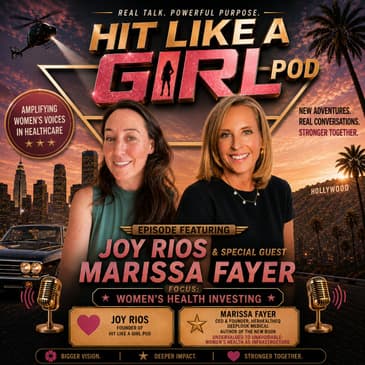
What if we told you that investing in women's health isn't just the right thing to do—it's the smart thing to do?
Marissa Fayer has spent 22 years turning that argument into action. She's the CEO and founder of the global nonprofit HerHealthEQ (deploying women's health equipment across 12 countries, serving 150,000 women) and the for-profit DeepLook Medical (imaging software that sees inside dense tissue). And now, she's the author of the new book Undervalued to Unavoidable:
Women's Health as Infrastructure.
In this episode of HIT Like a Girl podcast, Marissa joins Joy Rios to make the case that women's health isn't a niche issue—it's the foundation of a functioning society.
Tune in to hear:
🔥 The Economic Argument: Why framing equity as an economic imperative moves money faster than moral arguments ever will.
💰 Move Money, Move the Needle: How consumers, investors, and philanthropists can redirect capital toward women-led companies and solutions.
📊 The Stats That Shocked a Banker: Why a top executive told Marissa, "I literally cannot unhear this."
🧠 From Data to Action: We have the data. Now what? Marissa breaks down small, actionable steps anyone can take—whether you're in a boardroom, at a clinic, or at your kitchen table.
⚠️ The 35-Minute Gap: Why it takes 35 minutes longer to diagnose a woman having a heart attack than a man—and what that means for women's health outcomes.
If you've ever wondered why we keep studying the problem without fixing it, this episode is your wake-up call.
Key Points with Timestamps
[02:45] The Multipreneur Mission: Marissa Fayer, CEO of HerHealthEQ (nonprofit) and DeepLook Medical (for-profit), and author of Undervalued to Unavoidable, explains that her daily drive comes from impacting women's health globally through better screening, technology, and access.
[05:30] The Numbers Don't Lie: We have the data on the massive disparities in women's health, but talking about the problem isn't enough. It’s time to move from conversation to action.
[06:50] The New Economic Argument: To get traction, frame women's health as an economic issue, not just an equity one. Companies with women in leadership and on boards are better investments and more effective with capital, making it a smarter business decision.
[09:20] How to "Move Money": Action includes moving capital toward women-owned brands, asking financial advisors to invest in women-led funds, and supporting healthcare companies that prioritize women.
[13:00] What Anyone Can Do Today: You don't have to be a CEO to make a difference. Small steps include asking why there are no women in a meeting, advocating for menopause and elder care policies in the workplace, or sending a form letter to a congressperson.
[15:00] The "I Can't Unhear It" Moment: A top bank executive told Marissa he couldn't stop thinking about how women are systematically left out of infrastructure decisions, which was the catalyst for changing his perspective.
[16:20] The 35-Minute Gap: It takes 35 minutes longer to diagnose a woman having a heart attack than a man, leading to irreparable harm. This is because symptoms in women (like back pain and stomach issues) are often dismissed or mistaken for other conditions.
[18:30] The High Cost of Exclusion: Women were excluded from clinical trials until 1993, and enrollment is still only at 40%. Marissa argues that it is far more costly to retrofit products than to design them with women in mind from the start.
[22:00] Women's Health is Infrastructure: Just as we invest in repairing roads and bridges, we must invest in the health of women—because they are the foundation of a functioning society.
[24:00] Beyond Conversation: While we still need to share the facts, the priority is action. This means voting with your money, time, and resources to support women's health and leadership.
[00:00:09] Hi there. Welcome to the HIT Like a Girl Podcast. My name is Joy Rios and I am super thrilled about today's guest. We are speaking with Marissa Fayer and your list of accomplishments and impact is quite long. So I actually wanted to hear from you, what makes you like proud? What are you, what are the achievements that you love to share?
[00:00:29] It's such an honor to be here. I'm so excited. But what I love is the women who I impact every day and it's, I don't think it's one a day, but it's the women who have access to better healthcare, who have access to better screening, who have better technologies. And like that just, that's what gets me up every single day, no matter what I'm doing, no matter like what quote unquote title and thing that I'm working on that day. That's my whole purpose of life. That's what I do.
[00:00:57] That resonates a lot with me. That's something that I'm like, a question that I've been asking myself for a long time is basically when I wake up in the morning, what is the thing that I can do that is going to have the most impact and just starting from there? And I was curious, is that something that's similar for you? Does that drive you as well? For the past 22 years, I think it's been improving women's health in all different ways. And we can certainly get into that, but that's every morning that I'm like, okay, I got a job to do. And every day is not sunshine and rain.
[00:01:27] I got a lot of the rainbows and unicorns dancing across the living room and all of those things. But it's the driving force to say, this is what I get up for. And you've been doing it for 25 years. And for our audience, you own, you run both a nonprofit and a for-profit organization and are a new author of a book. So let's kind of hit on all three of those before we dig into more discussion. I'm the CEO and founder of global nonprofit Her Health EQ, and we deploy medical equipment
[00:01:54] to developing countries focused on women's health. We focus in cancers that affect women like breast cancer and cervical cancer, and then maternal health and heart disease, and really getting the practitioners on the ground the equipment that they need to diagnose, prevent, or treat those diseases. And it's just getting them whatever they need. And we trust them. We work with them locally. We're in 12 different countries. 150,000 women have had better health because of the work that we've done so far.
[00:02:24] We have a big goal for the next few years, hoping to inch that up closer to a million and obviously continue to grow to there. Secondly, I'm the CEO of Deep Look Medical, which is a software imaging for-profit company. We are in the imaging and radiology space focused on oncology, and we specifically can see inside dense tissue. And obviously, first and foremost, that means dense breasts. And so we're software that overlays on top of existing hardware and software.
[00:02:51] I am probably the new author of Undervalued to Unavoidable. And I wrote this book with no intention because I actually was looking for a book that answered my questions and I couldn't find one. So I stupidly said, let's just write one instead. How hard could it be, right? Yeah. How hard could it be? Just let me just start writing and talking about it and promoting a book and all of those things. So doing that, I work on the investment side of things.
[00:03:18] I'm also a new fellow to the World Economic Forum on the Technology Pioneer Program, representing one of my companies and just very much on the global stage on women's health. And I call it a multi-preneur because I also think just they all intertwine and they all have benefits mutually. And I think it's sometimes maybe this is what helps me get up in the morning. Like I need multiple things to do. And I don't know, maybe it's my crazy brain that needs multiple things, but I can't do just one thing.
[00:03:47] No, I totally understand that. And it sounds like you're also a super creative person. And so what you learn in one facet feeds the other. And that maybe just sort of like helps both of them or all of it get better. Yeah, that's interesting. People have been saying that lately. I'm the least creative human, I think, possible. But I think my creativity is maybe just different. It's just reprogrammed into... I mean, I'm an engineer. So maybe that's where it comes into. It's just efficiency and getting things done and making things happen.
[00:04:15] I guess that's my creative brain. I mean, I'm definitely not painting, dancing, doing any of those traditional creative things. But maybe the creativity is how my mind loops all the things together. You created a whole book. I think that counts as being creative. I thankfully had a good team of editors and designers and all those things. Well, it's one thing to do and be in the position of researching and writing. It's a whole other aspect to be talking about it and promoting it all.
[00:04:44] Those are completely different places to be. But I think that from where you are sitting, I feel like one of the conversations is we have enough data. We have learned that we have enough data about women. And now it's time to take action. So for our audience, what are those top pieces of data that we just hit on over? And yes, we know we're 51% of the population. And how much percentage do we get invested in women's health? Sometimes it's 6%.
[00:05:12] Sometimes I see stats that say 1%. And female founders, etc. But how do we move on from learning about all of what the stats are to moving into action? Because that seems to be where your sweet spot is. Yeah. And sometimes we need to think about it on a human level. So 35% of all deaths, of female deaths, they're due to heart disease. The fact that we're not or we haven't innovated in that space is ridiculous and atrocious. And that's 9 million women around the world that are dying, some of them unnecessarily.
[00:05:42] It's cervical cancer. It's 90% survival rate in high-income countries, but 50% in low-income countries. That means there's a disparity in screening and treating. Autoimmune diseases, 80% of all women are... It affects 80%. And only 20% men get. So you think about these things, these specific stats. And yes, the data varies between 1% and 4% and 2% and all of these different things.
[00:06:08] What we need to do is move to action because we can study this all day long. And there needs to be a ton of more studies that happen on things that we don't know about or things that women are affected differently and disproportionately, completely differently than men. But we need to start taking action because industry moves when action, is happening. And there's more proof points. Now, everyone's going to jump on me on that one. There are a ton of proof points. We have a ton of exits that were miscategorized in women's health. And now they've been recategorized.
[00:06:38] And it is billion trillions when exits that have happened in women's health. They just were categorized as oncology or hardware or electronics. So those kind of things, that data needs to get out there. But now we need to keep doing. And it's not just service providers. It's not just clinics and serving the 1%. It's action. It's innovation. It's making sure the innovation is applicable for both men and women,
[00:07:06] if that's what it is designed for. And women are on the design team. Women are in leadership. Women on boards. Women on policymaking, advocacy, all of these things. Women moving money. Moving money is probably the most important thing. And it comes in different forms. So let's take action on moving money. If you're a consumer, move money towards women-owned brands. Brands that support women that have women in leadership.
[00:07:32] That ones are, that have the workplace programs that are supporting women. That information is available. And again, I'm happy to provide it. Everybody's happy to provide it. That's there. So that's first and foremost. But if you're an investor, look at your portfolio and say, why am I only invested in men's companies? Or why, even if you're doing it through EFTs, like why are they not socially conscious? Why aren't they not women founded? There are specific funds in your investment portfolio that,
[00:07:59] like I diversified my portfolio and made sure and said to my financial advisor, like this is what I want to be investing in. And I don't care that you don't agree with it. Like this, I mean, they did. She did because it's a woman, thank God. But she said, great, let's do this. And like sad that we have to ask for it, but ask for it. So there's that. And then moving investment capital, but it's also, it is also philanthropic capital. It is rent making. It is everything. It's large, like the World Bank and the IFC,
[00:08:29] like there needs to be more women in the positions of allocating capital to women's health issues. And so that's how we start making change. And any human can do this. Yeah. But how do we do it? Right now, it's like equity is a bad word. So how do we do it without having those stupid keywords that seem to be working against us at this moment in time? Frame it in financials. It doesn't need to, equity doesn't even have to be part of the conversation.
[00:08:56] Say, oh, okay, well, these companies are doing better than these companies. You know why? It's because they have women in, on their boards and on their governance committees and women in leadership and that, those kinds of things. Like that's how you frame it. You, you frame it as an economic argument. That's what, and regardless, that's what moves money. This is not, it's not like a nice, like advocacy thing. We want to feel good. We said the right thing. No, no, we're kind of done with that.
[00:09:24] So what we need to do is frame it economically for everybody. And then maybe at the end you say, oh, this is actually, this is just a smart idea because it has to do with women. So you, like sometimes what I do occasionally is I'll almost like present the stats and keep the word women equity and whatever. It's like, would you rather invest in this company on the left or this company on the right? Here are the information, you know, the information about it. Everyone's like, oh, left, of course, like this is a better company. Yeah.
[00:09:53] You know why it's a better company? Because there's women on that board in the leadership team, more effective with their capital, et cetera. And it hits people like, oh, like, oh shoot. Like, cause I presented it without the word women, without the word equity, without any of the taboo current words. And the taboo current words are in our U.S. society. Sadly right now, they are not everywhere else. Europe is still completely investing in equity and women. And so it's still prevalent.
[00:10:23] It's just a blip right now for us. So you said something earlier about talking with your financial advisor. Like I have definitely looked at my portfolio and framed it and have a focus on sustainability and like socially responsible companies. But I didn't actually know that. Is there a way that I can go in and say, oh, I want to actually focus on women, like organizations that have. Okay. Yeah. Women-led funds. You can say, you can say healthcare funds that are led by women. Yeah. There is a way, like, I mean, that's what I said.
[00:10:51] I mean, I'm not only in healthcare, obviously, because that would just be a very diverse portfolio, even though it is still the most highest growth portfolio a lot of times, because it is related to tech too. So yes, you can go in and just say like, I'm happy to reach out to my advisor and get the names of the funds that, you know, that we specifically moved some capital to, because I think it's important for everyone to know. And there's more and more that are popping up every single day. And that's really great news. What is it that you're finding on your tour?
[00:11:20] Because you're having tons of conversations with incredible audiences. And what are some of the best questions that are being asked and conversations that are coming from it that maybe you have surprised you? A lot of people are just asking, like, I didn't know, or they're telling me, like, I didn't know how easy it was to start doing these things. And it's small. I'm not asking anybody to, like, become the president of the World Economic Forum.
[00:11:44] Like, I'm not asking people to, like, join the World Bank and, like, make this their mission forever. Like, I'm just, we're asking, like, I'm asking people to take one step and then tell one other person, or then you take one step a day. And then that's over 300 different steps that you've taken. And it could be as easy as starting, like, write a form letter that are already available to send to your congressperson to say, this is important to me because of X, Y, and Z. You know what?
[00:12:14] There's been a lot of laws passed because of that. And health care coverage granted for women because people have done that. People just do it out of the natural goodness of their heart to pass these rules and laws. Oh, yeah. Things like that are easy. So that's what I'm hearing is saying, is people thinking about it. But I'm also, while the book is about women's health, it's not geared just for women. I mean, this is geared towards everybody. I was just, a week and a half ago, we had a book launch tour here in New York.
[00:12:41] And one of the guys said to me, he said, I literally, like, I can't look back. Like, now that I've heard what you said, I cannot hear it. And I'm going to speak to my people. And he was at a very large bank. Like, I'm going to speak to our teams and say, like, what are we doing about this? Because I can't get it out of my head. And I said, great. Like, that's it. That was my job done. Like, the event was spectacular. And I said, that's it. I only need one. You only need everything to change, like, one person, to have somebody think about it,
[00:13:11] somebody to tell somebody to say, oh, my God, did you know about this? And it sets off, like, a chain reaction. So I'm hearing a lot of that. Again, the questions are, like, what can I do? And it's exactly what you said, Joy. It's, what can I do? I'm a random layperson. Like, what am I supposed to do about this? And it's whatever you can at whatever stage you are at. If you're inside of a company, there's so many things.
[00:13:36] Like, ask about your workplace practices for not just the fertility side of things, but also for menopause or elder care, things like that. Like, this debt disproportionately affects women. And it's very much unpaid work, too, taking a toll on women in the workforce, which are the strongest cohort of women who are impacting everyday decisions. So first and foremost, ask about that.
[00:14:03] If you're at a table in a meeting, you happen to be the only woman, or maybe there's two women, table of 20. I mean, I'm not saying be controversial because I'm controversial, but not everybody has to be. You can say it there. You can say it on the side. You can say it afterwards. But why were there no other women in this meeting? Or all the women are sitting on the back and the side? No. Not okay. You switch your chair over and you make sure that there's space physically for women at the table. This is not just metaphorically.
[00:14:30] Like, physically put them at the table and encourage them to say what they want to say. And that's how that starts. So it's things like that. It's when you're innovating in healthcare. I mean, make sure women are on the design team because, surprise, we think about things differently. And sometimes, if it's for us, we have some lived experience. So it's like those kind of things. It's wherever you are. You don't have to be the most senior leader. You don't have to be the CEO of the company.
[00:14:55] You simply have to just ask the questions and just be cognizant of it. What do you think that man heard that he couldn't unhear? Like, was it the infrastructure conversation? It was the fact that women were not included in a lot of these decisions and weren't included in building societies and that their fault, like, quote, unquote, falling through the cracks. Now, I don't know where this man, like, comes from because that must be a rock. And it's lovely that he's living under. But you know what?
[00:15:25] I hate to say it. There are more people than we think, men and women, not just men, who are living under that rock that are just trying to figure out. Like, I kind of didn't know that. Like, I think he conceptually got it. But when it's so in your face, how do you not get it? And again, like, I'm in New York City. I mean, we're pretty progressive here and talk about things. And diverse. And diverse and talk about things all the time. And we're pretty in your face about it.
[00:15:54] And I mean, he was at one of the top 10 banks in the world. And he's like, oh, I don't know if we think about this at our bank. And I was like, maybe you don't. Or maybe certain divisions do. And it was just really interesting, like certain facts. We had a cardiologist on actually on the panel, and she specializes in gendered cardiology. And like, again, most people think of a man, like when you get the image of somebody having a heart attack, it's a man in a business suit, clutching his chest and falling to the
[00:16:23] ground, walking down the street. Well, women don't present that way. That's not how they present. And actually, this physician was saying, this woman was having cardiac events for two weeks before she came in to see me because she thought it was like an upset stomach and a little back pain. That's how women present oftentimes in heart attacks. And it's just like, she was like, that woman had some irreparable harm done because nobody thought to ask, hey, are you sure? Like, maybe you should go to the doctor.
[00:16:53] Maybe you should see somebody. Maybe that's cardiac related. And I'm not saying every stomach attack and back pain is cardiac related. Certainly not that. We don't even know what to look for. So we wouldn't know it if we saw it. Right. And there's also, honestly, physicians that don't know that. And there's physicians that in the emergency room, it takes oftentimes when a woman comes in saying, I think I'm having a cardiac event, 35 minutes longer to diagnose her than a man because they're doing all the other tests to check. Right.
[00:17:20] If a man's like, oh, my heart, my chest hurts. Okay. Everyone's like, great. Let's get you up. No problem. 35 minutes. That is irreparable harm. There's been a meme going around on all the socials where it's like, it talks about the hormonal change, women versus men. And just like, hey, this is something that changes on a daily, if not monthly basis. And we've just decided not to study. Like, it's just not interesting. Like, oh, like, like there's nothing to learn from that.
[00:17:47] We're just going to study the folks who their hormonal, like it stays exactly the same pretty consistently throughout their life. And it's just kind of mind boggling when you frame it in that way. Like there is so much to learn. And we've essentially, as a society, just made a choice that it did, that it doesn't matter up until now, or it's inconsequential. I think in the beginning, it was made unintentionally. I don't want to say anybody had malice making these changes, making these decisions in the beginning.
[00:18:15] That was just how society was 100 years ago. Right or wrong, there's nothing we can do about it. That's the past. Now we have the ability to make those changes. And when you test on women who often represent much more complicated systems, you will get to a man. Like it will work for them too. It is far. And a lot of times they did it for cost reasons. So it is when you're doing clinical studies often, and especially back before AI and technology
[00:18:44] and all of these things to make clinical trials, especially with drugs and medical devices, easier to find different people, things like that. When it was, you're going to X, Y, and Z city and need to recruit X number of men, people, you know what, that have these things, naturally women are going to be excluded. Women weren't even allowed to be in clinical trials until 1993. And it seems like so long ago, but it's really not because like I remember the 90s.
[00:19:10] Well, and then they say that the data, the lessons that you learn from those clinical trials also takes like 18 years. So we started in 1993 and like actual results 20 years later, like that's yesterday. Yeah. Just a few years ago. And also the other thing is still clinical trial enrollment is only at 40% women. I mean, still. And pregnant women really have to go through a lot if they want to actually be enrolled in a study because nobody wants to take that risk.
[00:19:40] And when you think about post-effectiveness back then, it was like, let's just get this out as fast as we can on whatever. So like, we're not going to have to deal with hormones. We're not going to have to deal with when they're on their menstrual cycle. We're not going to have to deal with fertility. We're not going to have to deal with all of these things. We're not going to have to deal that they're different size, that it was not right. Nobody ever says that that was right. That just was how it is, how it was. And now we have to make that change moving forward, which now it is far more costly to go back and kind of retrofit.
[00:20:07] If you are designing something new, it is actually far more costly to include women from the outset. And again, we go back to saying it's economics. When you frame it in an economic argument to say you will have less retesting, less rework, less re-engineering, less cost to market that, et cetera, then like that changes the perception and the argument.
[00:20:33] Any executive, no matter if you're a man or woman, in any company wants less costs. You can do all of those things, including women, and focused on women first, instead of having to retrofit and do it again. And so again, that comes back to economics. And that's how the argument needs to be framed. Not, this is a nice thing to do. This is the right thing to do. This is like good for you and good for society, which it all is because I'm not, I'm definitely going to say that it is. It will.
[00:21:02] But it is economic. So we want more efficient companies. We all want to spend less money on everything. So if you spend less money on development and marketing and all of these things and R&D, well, you know what? The costs are going to stay a little bit lower. I'll be honest with you. A lot of my paramenopausal rage is aimed at the disservice that has been done to women at the lack of decades of research that we are owed.
[00:21:30] It just really infuriates me when I think of the consequences that generations of us are facing because of people's lack of ability to, I don't know, see a full picture. And so part of me just feels like we are owed the investment. We are owed a double, triple, quadruple down on the investment that was in our health and in just our well-being from what was essentially withheld from us for decades.
[00:22:00] Correct. And that's probably why I wrote the book, Is My Parent Menopausal Rage? Now that I think about it and I hear you frame it that way, that is probably why I wrote the book because I was so mad. Yeah. You're like, where is this information? How I am going to create it if it's not out there? People need to know. Yes. And we have been done this huge disservice. So I'm really grateful for the work that you're doing out there. And I mean, I guess also when you claim it as infrastructure and the conversation around
[00:22:28] just economics, I love the fact that it's much more difficult to debate. Like our well-being and health is not up for debate. It should be just built in and we shouldn't be like, to your point, you're not doing us a favor. This is not like because we've been good girls and we deserve something nice all of a sudden. It's like, no, this is injustice that has been handed to us for a long time. And we need to right the wrongs as far as I'm concerned.
[00:22:56] We think about a road that needs repair. Okay. Well, same. We put tons of money to that. Like that's the infrastructure argument to say, if you're willing to invest in roads and bridges and buildings, well, then you need to invest in the health of your entire society that are going to be using those roads, those bridges and those buildings. Because we can't as women, because we're not healthy to use them.
[00:23:25] What's the point of even doing the repairs then? Good point. So do you feel like we're having a different conversation than we were having about investing in women even five years ago? Yeah, I think we are. I'm starting to see it. I think there's still pockets of people who are still coming around to it and still hearing it just for the first time, which again, we need more people. So we still need to have those conversations. I think the conversations, myself and a lot of my colleagues who have been in this for a really long time, we're sick of having the conversations.
[00:23:54] And I am sick of just stating the facts. And I think a lot of people are coming around to that. There still needs to be a lot of people stating the facts and working on the stats and moving things towards it. But there needs to be a lot more of us moving towards the action stage of where we are and what we're doing, because that's the only way change starts to happen. And so for our listeners, essentially, that is spending, like voting with your money, right?
[00:24:21] Just being really specific about what you put your money towards, what you put your attention towards, who you give your time and resources to. Exactly. Well, Marissa, thank you so much. I'm so excited for your book. I can't wait to read it. Can you show it to our readers and let them know where they can find it? Yes, of course. So undervalued to unavoidable, Women's Health is Infrastructure. It'll unzoom itself in a second. And it is available on barnesandnoble.com, amazon.com, or on my website, marissafayer.com.
[00:24:50] And we'd love for everyone to pick it up. If anybody happens to be any of the locations I happen to be in, I am happy to sign a book and get it to you. And we have tons of events coming up. So it's really exciting. I'm really excited for the work that you're doing and sharing the knowledge that you are and getting folks in positions of power to make different choices. Like, let's do it. More action, less talking. I'm on board. So thank you for your time today. Thank you so much for having me.
[00:25:19] Thanks so much for listening to this episode of Hit Like a Girl Pod. If this episode resonated with you, please follow us on social media at hitlikeagirlpod. That's H-I-T, like a girl, P-O-D, across all platforms. And to learn more about the show, our guests, or to join our waitlist for what's coming next, please visit our website. The link is in the show notes. The Hit Like a Girl podcast is built on joy, fueled by love, and led with grace. We're so glad that you're here.
[00:25:49] We'll see you next time.