
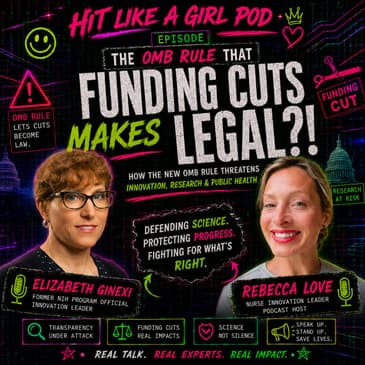
This episode is a call to action—and we have until July 13th.
Rebecca Love sits down with Elizabeth Ginexi, PhD—a former NIH scientific program official of 22 years who took early retirement after DOGE restructured the agency. She is now speaking out about a proposed OMB rule that she believes threatens the future of federal funding across every community in America.
The rule rewrites the Uniform Guidance (2 C.F.R. 200), quietly shifting it from "guidance" to "regulation." Elizabeth argues this is designed to bypass Congress's power of the purse—giving political appointees unilateral authority to block, steer, or cancel grants at will.
That means $48 billion in NIH funding. Plus Head Start. Plus Title I schools. Plus Meals on Wheels. Plus infrastructure projects. Plus every discretionary grant program that communities rely on.
This is not just about science. This is about every community in America.
*But there is a 45-day window to oppose it—and it closes July 13th.*
Elizabeth walks us through the mechanics of the rule, what is at stake, and—most importantly—exactly what we can do to fight back. She has written easy-to-follow guides and will provide links to submit a comment to the Federal Register and contact your elected officials.
We have until July 13th. Your voice matters.
Listen. Then act.
00:00 The Stakes: Why This Matters Right Now
04:04 What OMB Does and Why It Matters
06:43 From "Guidance" to "Regulation": The Shift Nobody Is Talking About
07:51 Congress vs. OMB: A Power Grab
11:10 How NIH Funding Works—and How This Rule Could Break It
13:00 Political Control of Grants: What That Looks Like in Practice
15:51 NIH's ROI: $48 Billion and Why It Matters
18:57 Beyond Science: Head Start, Infrastructure, and Every Community
23:03 How to Fight Back: The Two Actions You Can Take Today
26:44 Writing Effective Comments (No Expertise Required)
29:31 Use Your Voice: Why Silence Is Complicity
31:10 Final Thoughts & Where to Find Resources
[00:00:08] Hi everyone, my name is Rebecca Loven. It's an honor today to be on the HIT Like a Girl Podcast Reboot Series with a guest of mine, Elizabeth Genexi. Elizabeth was a scientific program official with the NIH for over 20 years who decided to step back when DOGE came in and restructured the entire NIH program. We're honored to have her on today because we are facing a moment in time in which all financial federal funding is facing a dramatic change of proposed rules that are going to affect every aspect of American life as we know it. This is a code of
[00:00:38] read not only for science, but for almost any organization that is seeking federal funding. And we felt that it was imperative to bring this voice and narrative and honestly, one of the most courageous representatives of people of our time stepping forward to bring an issue to educate others. So Elizabeth, it's a pleasure to have you with us. Thank you for taking the time to have this conversation today. Thanks for having me. I wish it was under better circumstances. You do, but thank you for taking all the amount of time. I know I hounded you to come on these calls and you've been inundated.
[00:01:08] And can you step back and tell us what happened? How have you become the face of this entire situation that is facing what we now refer to as the OMB, financial future that is going on? Can you step back, tell us a little bit about what happened and why you have become this spokesperson? Sure. So as you mentioned, I worked at the National Institutes of Health for 22 years. I was a scientific program official there, which means I oversaw a large portfolio of grants in science for many years.
[00:01:38] Helped write funding opportunities, helped launch the careers of many scientists and so forth. But after Doge came in and really destroyed the place where I was working in, I quickly learned that our job was going to be looking at spreadsheets to cancel grants. I didn't really want to be a part of that or to help think up new initiatives to satisfy RFK Jr.'s Maha initiative. And I didn't want to do that either. So I took the early retirement offer,
[00:02:06] hoping that I could just get a job on the outside, which has proven quite difficult because they've crashed the economy here in the Washington, D.C. area and there really aren't any jobs or there are few, but there's too many people who want them. So I began writing on Substack about my experiences at the NIH because really, I was traumatized from being pushed out of my job. And I had no intention of leaving at that time. And it was really quite therapeutic just to write about.
[00:02:35] I had no idea that people would listen to what I was saying or even be interested. And lo and behold, some of the Substacks really got some traction with people who were hungry to hear what's happening inside the agencies. And in that spirit, about two weeks ago, I was at a scientific conference in Washington, D.C. when news broke about a new rule from OMB.
[00:02:59] And I have been tracking the attempts of OMB to destroy the NIH for the past year. So I was keyed into this and I quickly downloaded this 400-page document to my laptop. And as I sat in these sessions, I was reading through it in the PDF viewer and using the little highlighter tool. Each time I came across a new section that I just thought was outrageous. So quickly highlighting, oh my gosh, this is terrible. This is horrific.
[00:03:28] And after some time of reading that document, I turned to some of my colleagues at the conference and tried to engage them on this subject. And I quickly learned that they had no idea what OMB was. They didn't know who Russell Vogt was. And they really didn't think a rule from OMB was too terribly interesting to speak about. So not right. So I think it's actually, I'm guessing that some of our audience probably feels the same way. Let's start first. And what is OMB? And why does...
[00:03:57] Exactly. I realized I need to fix this. So most people don't know what the Office of Management and Budget is because it has been a pretty ho-hum office in the White House. And it's basically a budget office. They help with the accounting and the distribution of the money that is allocated for various agencies and programs. It's allocated by Congress, right?
[00:04:21] So Congress creates the programs that are intended to benefit the American taxpayers, the American people in the communities of the states. And money gets funneled through this Office of Management and Budget and then dispensed to all of the different agencies. And essentially, for the longest time, you wouldn't need to know anything about that office.
[00:04:43] But right now, the office is being held, being directed by a man named Russell Vogt, who is one of the key authors of Project 2025. And people might say, oh, I think I remember that from the elections. Well, if you read that document, there is a section on a lot of the agencies in there. And I'll start with NIH because that's my expertise.
[00:05:06] If you read the section about his intentions for the NIH, you'll quickly learn that he doesn't really believe that the NIH should even exist. And it's part of his philosophy. It's an extreme libertarian viewpoint that believes that taxpayer monies really shouldn't be funding all of these grant programs, all of these government programs, assistance programs. They have a very narrow view of what government dollars should go for.
[00:05:31] And it's mainly military and helping corporations get rich. So this office, which most people don't know, has for many years provided guidance documentation to the agencies to make sure that the monies that are appropriated by Congress get to the people that it's supposed to go to in an efficient way and a way that follows all of the rules, all the policy guidelines.
[00:05:58] There are rules for costs that are allowed and costs that are not allowed. It's pretty boring. And that document has been referred to as the uniform guidance document for all of the agencies. This is the exact document that Russell Vogt has decided right now he's going to completely rewrite. And it's a document called 2 CFR 200, part 200. Would never need to know something like that. And it's 400 pages of previously just guidance.
[00:06:28] What he's doing, though, is not guidance. He has, if you look at the document like I have, replaced the word guidance well over 400 times with the word regulation with the intention of giving himself a magical power of becoming a regulator. So what he intended, it's never happened. And can I just step you back? Yeah. Because what you just laid out is a highly complex series of steps that took what was a guidance document.
[00:06:55] And basically with a sweep of the pen is what you're saying. This is turning it into a regulatory document without any oversight, just by his decisions to do those things that are now going to fundamentally change how all financial dollars are going to be activated through the federal government at this point in time with him as being a sole decision maker on these changes.
[00:07:17] And can you explain real quick as you were just saying this, by switching from guidance to regulation, what does that make that document differently from what people before may not have been aware of to now why this is a critical moment in time of what's taking place? That's right. So essentially, it's trying to take away powers that Congress has. So Congress has the authority to make programs for the people, right? They can create Medicaid. They can create Medicare, which they did.
[00:07:45] They can create Meals on Wheels. They can create any program that they want, and they can allocate dollars to it. And the Office of Management Budget cannot veto those programs. That's not part of the law. That's not how it works. But because he doesn't like these programs, he's going to try to cancel them. And last year, he tried to do that for a number of different programs. There were thousands of NIH grants canceled, NSF grants canceled.
[00:08:14] There were attempts to cancel infrastructure grants in some of the blue states. There have been numerous energy grants for clean energy and also a variety of things that were related to Biden's legislation to help people modernize the efficiency of their homes, all these kinds of things. And they don't believe that money should go to that. So the court struck it down. Yes. That, no, you have to spend the money. That's Congress's authority.
[00:08:44] Congress has the power of the purse. You do not. You just spend it. So this seems to be his latest scheme to get around that and take a second crack at the apple, right? He's going to try again to take control of these programs that are authorized in law by Congress and use this rule as the way to do it. And thank you for sharing this because this is a completely unanticipated use of what I think first people first read of this document.
[00:09:12] I think to your point, what you have now further uncovered is that this is allowing the OMB to suddenly become a veto power over Congress's discretionary decisions of spending and supporting a programming that Congress, the elected officials in this place, who are supposed to represent the American people and fund programs that they find vital to national security, public health, and basically general Americans' well-being, can now be vetoed by an OMB.
[00:09:38] A party that is neither elected nor in a position historically to have been in this position to do anything besides just provide oversight and guidance on how such grants should be applied for purposes of such funding. Can you explain a little bit, Elizabeth, I know you are not a historian by trade or a scientist by trade.
[00:09:59] So bringing it back down to the science community and those that also are listening into this audience, which are largely healthcare informatics technologists in these spaces, what does this mean for individuals who right now have been working in healthcare? They've been engaging with the scientific community. They are in universities and organizations that are building scientific research and outputs.
[00:10:22] What things do they need to be aware of in addition to this striking moment of changing congressional power and authority to what it means from a day-to-day perspective for scientists with regards to what you read into within this document and those changes? That's right. So if you are a scientist or an organization who applies for grants from the federal government, you would generally apply for those grants from the agency that you want to get it from.
[00:10:51] So in my case, I'll talk about the NIH because I know it best. Scientists submit their ideas for clinical trials, basic science, all manner of biomedical research to the NIH. And by law, when those grants come in, the NIH is required to review those grants by scientific peer review.
[00:11:10] So we have what's called study sections, where we convene external experts, scientists of the topical areas who review, score, rank, and really rate those applications. And then by law, there's a second level of review done by what's called advisory councils. And they're also external scientific people. And they basically look at what the first level of review did and make sure that it was done properly and that they concur.
[00:11:38] And once that process is done, the grants are now eligible to be paid by each of the NIH institutes and centers. And people like me, program officers, would work with the leadership at our institutes. We'd take a look at those scores. And our goal was to fund the most meritorious science. And based on the scores, we would generally fund in that order. Sometimes we might change the order. For example, if we knew that a particular grant was studying something so similar,
[00:12:06] and we already had five other grants doing the same thing, maybe we might skip that one. Or if there was something lower on the list that was super high priority, we could bump it up a little bit. So we had a little bit of leeway to go with that. But we generally would follow the review. What is going to happen now is the political appointees will decide what gets funded. And they're expressly told that they're not supposed to look at the peer review.
[00:12:34] And that is a violation of the statutes that created the NIH. And so, step me back one more time. You just said that, so for historical perspectives of founding documents that funded basically and established the NIH, which was to lead the most and determine which grants based on meritorial reviews by scientists, experts in these fields, is now being replaced with political appointees as opposed to scientists. Is that, am I understanding that correct?
[00:13:04] That's correct. So I think they'll, it seems that they'll let the peer review continue, but it'll be somewhat of a charade, if you will, because the deciders who will be political appointees from the White House, from OMB, presumably in each of the agencies, will be the deciding factor for every grant. And they can deny these grants for any number of reasons based on how they've rewritten this rule.
[00:13:29] They could say that they think your grant is DEI and they're not going to fund it. They could say, we don't like your grant because you want to involve a collaborator in Canada and we think all research should be American only. Or they could simply just not tell you at all and decide not to fund your grant. So it will become a very opaque process, open for really corruption and cronyism. And that is not the way the NIH was designed by Congress.
[00:13:59] No, I mean, let's be honest. I think the world knows that the U.S. leads in science because of the processes they've put forward by actually establishing based on meritorial review and science and facts and historical precedents that allow for us to go through a process that keeps people and focus directional in the way that is going to move the needle forward. And I think what you're saying is more that the time that this opaqueness comes in and cronyism
[00:14:24] and with almost this kind of belief that things that are going to be funded are determined by political appointees as opposed to the science in which it stands risks a substantial future for what is science in this country. Can you give us a scale and scope, Elizabeth, of how many dollars or how many grants a year are we potentially looking at at this point in time or when you're there? So can you tell us also from what aspects for people that are like, you know what, that's great,
[00:14:49] but I actually don't apply for NIH grants, but I think people don't realize how impactful these NIH grants are actually across all settings and all institutions. And you may be unaware that the work that you're doing is actually directly funded or impacted by NIH. Can you bring that down to the audience who is potentially listening here? Sure, yeah. So the current budget of NIH is somewhere around $48 billion a year.
[00:15:11] And having this peer-reviewed science has produced many, if not all, of the drugs that you're taking now and any of the cures that we have. We've sequenced the entire human genome, which has led to therapeutics for things like sickle cell that we never had before. We have antiretroviral therapies for HIV, vaccines for polio, hep B, HBV, COVID-19.
[00:15:38] We have treatments for cancers that were uniformly fatal within living memory, now all made available by the research that has been conducted. And it's not just that we fund research. It turns out when economists study the NIH, the financial, the federal financial investment to the NIH returns for every dollar that it invests, it returns about $2.57 in economic output.
[00:16:06] So it creates jobs, it creates patents, it creates all of the developmental research that undergirds pretty much every drug that goes through approval at FDA. So the companies, the psoraceutical companies on the back end are benefiting. And you are benefiting in the health that all of this has generated. So if we stop funding all of that now, the rare cancer that we don't have a cure for now,
[00:16:34] we won't have that cure for you 10 years from now. That's what we're looking at. And I was talking with two other scientists in this space, and that's exactly what they're saying, is that all of a sudden, everything that is undergoing the current clinical trials, the current development, at any point in time, these things now can lead patients and many places to suddenly abandon research and experiments and things that are critical to these critical aspects of both healthcare and human health that are now at risk of what's happening. Now, you also mentioned that, Owen, and I appreciate you giving us this, how this is being,
[00:17:04] and also the economic impact of the NIH. I mean, $48 billion a year is a complete economic moderator, but what you're saying is that that is actually equivalent to over $100 billion a year and economic activities that is generated for the NIH on really critical issues that are moving forward human interest. You fed something when we started this conversation that it's not only the future of science that's actually happening here, but this entire change of what's happening with the OMB process
[00:17:30] is actually not only going to affect NIH grants, which I think you clearly articulated, but this actually is having far greater impact and reach beyond just science at this moment. And I want to take a moment to talk a little bit about that, Elizabeth, and what you mean by that and why others like executive leaders across all these systems are going to want to pay attention to some of these things, because you even mentioned things like Meals on Wheels, and I believe that there's impacts to transportation and other kinds of
[00:17:58] public health initiatives are all potentially being impacted by this. Can you dive in a little bit into that? Yes. The way that we get a lot of things done in this country is through grants. So let's say a state has some need. They've got a large bridge that's been out for a really long time. I'm sure there's plenty of people that can think of one. And they're very expensive. So they may not be able to raise that revenue quick enough in a state. And it's a dire situation. We need cars to get across this bridge.
[00:18:28] So what happens is Congress says, all right, we're going to help you out and we're going to give you X amount of millions to do that bridge, right? So we had this infrastructure bill that was passed under the Biden administration. And they give that money to the states and the states use that grant money to hire contractors to get all the surveying people. It's a huge operation. Lots of jobs are
[00:18:51] filled from these grants. So if you have a federal transportation grant that's fixing something in your community, this rule covers that, which means they could cancel that. We're saying that these changes that are coming to the OMB are not only going to impact NIH, but any kind of federal grant that is given to a state that deals with infrastructure, any kind of project within that state could potentially be canceled or vetoed by the OMB at this point in time being overseen by
[00:19:19] political employees. And what I think we're inferencing here potentially is that there is greater risk that if you're not in alignment with the political direction of those ones, states that are expressing opposition and could see those grants being canceled or vetoed by the OMB. And I think that there is some speculation. We're seeing some of this play out in places potentially like Minnesota and California currently, not because of the OMB changes, but because of attempts to do so that I know are currently
[00:19:46] being challenged in the course. But I think what you're saying is if these changes happen to the OMB, there actually is now a regulatory framework that establishes less ability for states and others to challenge the cancellation of these grants and financial federal dollars. Is that what I'm understanding from you? Yes, that's the purpose of this is we spend a little over a trillion dollars a year on these
[00:20:10] discretionary grant programs, everything from educational programs, special education, low income assistance for kids in schools, head start, broadband, internet expansion, you name it, maybe drinking water systems that need to be upgraded and on opioid use treatment for families who have members that are suffering from substance use, no problems. All of these things are paid for and are potentially on the
[00:20:38] chopping block. So what will happen is for every grant now, there has to be a political person who determines that it meets their interests. And they don't if they will prevent new grants from being awarded if they don't think they meet their objectives. And it also grants them the opportunity to cancel any current grants. So retroactively, even though we awarded something to your community, now this gives OMB the
[00:21:07] power to cancel and take back that money. I mean, obviously, this is petrifying in a number of ways and deeply concerning that suddenly established programs funded and directed by Congress could be overturned at the whim of political appointees, which no matter who is in office, it is a risk to anyone doing those things. And it is the wrong precedent for which both the American foundation, I believe, of our democracy and our Congress is established to suddenly create a department that would allow to overwhelm the will of Congress, which has always been
[00:21:35] given the access to prove the purse or the dollars that is invested into which programs it needs, and is suddenly being moved under the direction of the executor office and one that is clearly going to be directed by political direction, which is, as we know across history, has never worked well for any kind of direction for future growth of the country. But also just amazingly shocking that we are living this in the United States. So, Elizabeth, what can people do? I mean, obviously,
[00:22:01] this is overwhelming, but the reason we're having this podcast is that we're here because we have a window of time where we can actually fight back against what is happening and be very constructive in what's happening in this debate, but also make a substantial impact that not only can impact the outcomes of this ruling, but also give the courts and other organizations an opportunity to potentially fight this legally. And this is where everyone who is listening today steps in and can
[00:22:29] actually be a part of helping prevent these changes from happening. Can you tell us what actions we need to take? Yes. So they're doing this to get around Congress and to cut your money off of your community, but they're counting on Americans not noticing until it's too late. We have a 45-day window which started when this rule was published and it will lapse on July 13th to express our opposition about this rule on the Federal Register, on the docket, and we can provide those links for you.
[00:22:59] It's a very simple thing to do. And you do not have to be a lawyer. You do not have to be a scientist. You can just be a person who does not like the idea that your grant monies could be canceled to your community for any reason whatsoever by the White House. And I have written some nice descriptions of how to do this. We've never written a rule like this, so we can point you to those tools. So what we're trying to do is get overwhelming opposition into the Federal Register. That's the
[00:23:27] historical record. I would love it if we could get a million comments of people saying, no, don't do this. And that will do a couple of things. One, it will trigger Congress because this whole rule was created under a congressional review authority, which means Congress has oversight and they could, if they wanted to, simply pass a joint resolution and block it. That would be the most expedient outcome. If we register massive amounts of opposition through the Federal Register,
[00:23:58] I think that will help signal to our electeds on the Hill that the American people don't want this. And number two, we need to write and call our elected officials in the House and Senate and tell them that we oppose this as well. So we're taking this two-pronged approach. There are a number of us who are in direct contact with leadership on the Hill, so we're working that as well. Right now, my sense is the Democrats are on board with us and they'd like to block this,
[00:24:25] but we need to convince the Republicans to join us and convince them how disastrous this will be financially and otherwise for our country to allow the White House to take their power away from them and overrule all the legislation that they have created these grant programs. Time is of the essence. We don't have much time. That's deliberate, but it's very quick to put a comment and we have
[00:24:53] lots of resources to help you with that. Anybody's voice is needed here. We need everybody, all hands on deck to really demonstrate to Congress how much opposition there is. Absolutely. Elizabeth, I love that you gave these two ones. And so everybody knows that is listening. July 13th is the deadline. We have a moment in time to actually make our voices heard. As she said, please log into the Federal Registrar. We'll be including links into this podcast with this, both to Elizabeth Ginexi's writing of her substack with specific directions, but also to the Federal
[00:25:22] Registrar and also with regards to links to being able to call your federal officials. One thing that I think we should build on, Elizabeth, is that the truth is, though, these comments should be structured in a way that also provides significant evidence and a logical argument that actually can do it. So just saying, no, we don't want this is not going to go far enough to be effective as a comment. It might catch Congress's attention with a million people independent saying there's things. But for people that are listening here and that are going to be
[00:25:47] affected by these changes, not only potential to NIH funding, as you were saying, but if their people are being supported by Head Start programs or Meals on Wheels or programs that they're dealing with on bridges that are no longer getting funded or infrastructure bills in their community or jobs that are coming their way and they're concerned by this changes, what things should they include within their comments that would be beneficial? Just a couple of key highlights, Elizabeth, that help them present this
[00:26:14] argument that is going to take it beyond a comment of, no, we don't want this and it's thrown out versus no, we don't want this and here is why. Can you give them some tips and tricks so that it could be counted in a way that also those who review those comments and are going to be forced to respond, this will take time and effort and also set up greater debate, which is really what we want to see happen in new spaces. What is your thoughts? Yeah, that's a great question. So any comment that's written in your own words, you don't want to copy anybody else's words. You want it to be unique
[00:26:44] and you can talk about your own life and your own community as testimony. So maybe even a few sentences about what you find meaningful and what would be damaging for you. So let's say you are a teacher in a high poverty school area, you could be worried that Title I funding could be cut. And what would that mean for your school, for your students? What would it mean if an infrastructure project was
[00:27:11] canceled in your community? Who's going to pay for that, right? Maybe you're a beneficiary of the contracting jobs for that bridge, right? Your uncle or your dad might be building that bridge. They'll lose their job. Head Start programs. If those get canceled, there are teachers who are paid for those programs who may lose their jobs. The kids lose their schooling. Moms and dads are usually
[00:27:36] using Head Start to allow them to go to work while their kid's in school and they're going to be suddenly saddled with childcare costs, right? So these are the types of examples of things that could happen if grants are canceled. Talk about how stressful that would be to not know if your programs are going to be at the whim of the White House. Any one of these programs. I have some ideas on my sub stack. You can read through and get some ideas and just put together a very short paragraph,
[00:28:06] few sentences in your own words. And I was like, Elizabeth, I appreciate you giving us advice. And what I always find is individuals feel very scared by using their voice. Even picking up the phone, they wonder if it makes a difference. And I just want to say, and I'm hoping you can also expand on this, is we recognize one of our greatest powers that we give away easily is our voice. By remaining silent, it appears that we are complicit and that we are in agreement with the things that are actually going on. And what
[00:28:30] most change always happens is when small groups of people start to use their voice to drive those changes. History has shown it time and time again. So anyone who is listening thinking my comment is not going to matter, me calling my elected official is not going to make a difference. I would argue inherently that history has shown time and time again, it is in fact the most important action you can take. Do not give your voice away. Do not be silent in this moment and take the action because we have a limited amount of time. And one day in the future, when you look at your own kids
[00:28:59] and they asked, what did you do during this time? You can point to concrete actions that you took to defend their future. So with that being said, Elizabeth Genexi, and it's out of the pleasure, congratulations on being a voice that I know you did not expect, but you were becoming. And thank you because I have to tell you, I reached out to many individuals about this topic and many people were too scared to step forward and use their voice at this time for fear of retribution of what it means
[00:29:27] of speaking out in today's world. So I just wanted to tell you, thank you for doing what you're doing. Thank you for spending time with us. And with that being said, what final word or anything that we did not cover, would you like to share with individuals on this podcast? We'll be, of course, sharing where they can find you on LinkedIn and other comments along those lines. But please leave us with one final thought. Sure. So I could just be hopeless about all of this. But once I realized
[00:29:52] how many people were persuaded that this is important, it just really, I don't know, I think it surprised me. So I think the power of us collectively working together could defeat this. And, but we need everybody. I looked at it from initially from the point of view of a scientist, but I realized this is bigger than just science. It's really every community and the harm that this
[00:30:19] would do will reach every community in America. And I think we should fight against that with every power we have. Elizabeth Genexy, I could not say it better myself. For everyone who tuned into Hit Like a Girl podcast, thank you for joining in and listening to these conversations that we feel are most imperative to the future of our country and often being expressed and voiced by women, stepping forward using their voices to drive narratives that are necessary more so now than ever before. So we look forward to seeing you in the future. Elizabeth Genexy, thank you for your time
[00:30:48] today. Thanks for having me. Thanks so much for listening to this episode of Hit Like a Girl pod. If this episode resonated with you, please follow us on social media at Hit Like a Girl pod. That's H-I-T like a girl, P-O-D across all platforms. And to learn more about the show, our guests, or to join our wait list for what's coming next, please visit our website. The link is in the show
[00:31:15] notes. The Hit Like a Girl podcast is built on joy, fueled by love, and led with grace. We're so glad that you're here. We'll see you next time.