
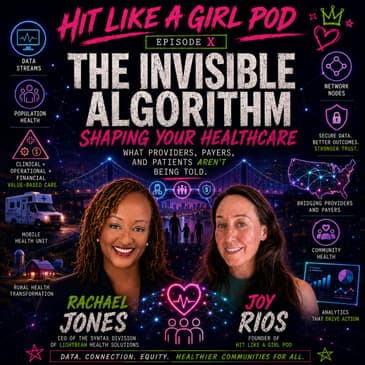
Healthcare is complicated. But the math behind value-based care? It doesn't have to be.
In this episode, Joy Rios sits down with Rachael Jones, CEO of the Sintax division of Lightbeam Health Solutions, for a conversation that weaves together data, dollars, and the deeply human side of healthcare transformation.
Rachael pulls back the curtain on what population health actually means and why the "perfect triangle" of clinical, operational, and financial insights is the key to making value-based care work for everyone.
They tackle the tough questions:
How do providers and payers actually speak the same language?
What happens when funding disappears and rural hospitals close?
Why is the "webbing effect"—the intersection of government, commercial, community, and individual responsibility—the only path forward?
They also address the elephant in the room: trust. From shifting policies and DEI backlash to the challenges of accessing complex programs like Rural Health Transformation funding, they get real about what it takes to sustain the gains we've made.
And yes, they go there. Breaking taboos around menopause. The power of sisterhood as "built-in besties." Why self-advocacy (and maybe a little magnesium oil spray) can change everything.
Rachael shares why she remains hopeful because providers in community health centers are still showing up every day. Because data can surface the right interventions at the right time. Because when women speak up, the world listens.
If you've ever wondered how value-based care actually works, or why it sometimes feels like it doesn't, this episode is your guide.
Listen. Then ask: Who's in your web?
[00:00:08] Hello there and welcome back to the HIT Like a Girl Podcast. My name is Joy Rios and today we are with Rachel Jones from Syntex. And I would like to give you a moment, Rachel, to say one, welcome back. It's nice to see you again. We spoke several years ago and I would like to give you a moment to reintroduce yourself to the audience.
[00:00:27] Rachel Jones, Well thank you so much for having me back and I'm super excited to have a chat with you again. It's always a pleasure, Joy. I'm Rachel Jones, CEO of the Syntex Division of Lightbeam Health Solutions. So that's a new change. Since the last time we spoke, Syntex was started and still is very focused on making value-based care simple through transparent math and much better automation.
[00:00:52] Rachel Jones, And we were acquired by Lightbeam Health Solutions, a population health and analytics company, back in December of 2025. So that's a new change. Rachel Jones, Well, that's it. Rachel Jones, I'm sure that's like a big change. So can you walk us through what is that? I imagine it sounds like a bigger team and more folks working on perhaps some of the same complex problems. Rachel Jones, A100% Lightbeam Health Solutions is a value-based care company. It was started over 12 years ago, I think almost 13 years ago now.
[00:01:22] Rachel Jones, A100% Lightbeam, The company in the past, you might have heard that company in the past as well. And what Lightbeam focused on and why it was so complimentary to us at Syntex was that Lightbeam was focused on all of the clinical and operational workflow challenges that providers and payers are working through in value-based care. How can they thrive in value-based care? Right? So I know you know the math and you know the sort of simple sort of foundational elements of value-based care.
[00:01:48] the population health piece of it is a big part of just understanding who, why, and what, right? Who are the members that we need to intervene? What's happening or why is it happening? Why are we seeing the trends that we're seeing? And then what do we do about it, right? How do we intervene either through the patient, directly to the patient or to that provider to help guide and influence behavior? So Lightbeam was already doing all of that. They had tremendous data ingestion
[00:02:14] capabilities, great AI capabilities for understanding risk and rising risk and driving and influencing clinical and operational care. What they didn't have was the actuarial piece that we brought to the table, right? So thinking about the sort of how much is it worth, right? When you're thinking about limited resources and trying to direct engagement with a provider, you want to sort of guide them and steer them towards the pieces that are going to matter most in their value-based
[00:02:41] care contracts. And to be honest, a lot of providers don't understand their value-based care contracts from an actuarial math perspective. So what syntax does is we highlight and we surface those financial details through our platform and our services to help providers and health plans speak the same language and really understand what is that contract worth and how to perform under that contract. So when you marry that financial insights with the clinical and operational
[00:03:09] insights, you really get that perfect triangle, right? And you really pull together a very powerful, compelling offer for our clients. Now, when we talk about population health, that sounds really big and vague. So can we get down into the weeds for a little bit when you're saying like, oh, some of the data, like what might be the things that you're tracking in population health? I know, but so what comes to mind, I'm thinking like, oh, when a company comes in and pollutes water in a community and like looking at like, okay.
[00:03:39] That's public health, right? There's public health and there's population health and population health. You're right. It's one of those ubiquitous terms that we throw around and we sort of take for granted that people know what they mean. In our world, in the world of value-based care and alternative payment models and models that are rewarding providers for influencing care outcomes through quality and cost interventions, we mean the health of the attributed population within that value-based
[00:04:08] care construct, right? So that is, I've got a thousand members who are seeing me as their primary care physician quarterback. When I talk about population health, it's all the health concerns for those patients, right? The ones who are older or younger, who's having babies, who has diabetes, who has congestive heart failure. It's their, it's that population and their health outcomes.
[00:04:35] Digging in on that piece, I have a question about, okay, when we think about the population of, let's say, maternal health and the change in leadership over the last couple of years has like sort of made the DEI aspect of everything sort of go away, what we call things. So I'm like, okay, are we measuring maternal health or, and are we also measuring black maternal health and getting in? Because I think that
[00:05:02] there's different results based on what it is we're studying. So to that level, is that something that you, is on your radar and that you get to talk about? It never left. Look, I think that as much as there is so much politics involved in the regulation and the policies that govern our healthcare industry, at the end of the day, every single person that's working in healthcare is doing it because we know that health outcomes matter. A healthy
[00:05:32] population is a profitable population. A healthy workforce allows us to have strong homes and healthy kids and a healthy nation, right? So there is, there's never been a situation where we're like, that doesn't matter. What you're calling out, and I think appropriately so, is sort of some of this backlash has been this idea. If I pay attention to one, I somehow exclude the other, which is really weird to me because
[00:05:57] if I'm being treated as a patient, I am being treated, right? So you have to think about what is unique and different about my care that's different from your care, Joy, right? So I think ask a physician, ask a nurse, ask a clinical leader. Those, the concept of personalized medicine has never sort of left the chat. That's always been a part of the conversation. You are right that because some of
[00:06:24] these political wins, we've had to rename things or call things something else. But social determinants of health, which is a fairly broad and popular term now, is all about recognizing the unique differences that we have as different parts of the population that impacts our health. Where we live, where we go to school, how we, what we eat, how much we make, do we have reliable transportation,
[00:06:50] all those things factor. And they're also predeterminant factors that impact our health because of our racial and ethnic makeup, right? Me as a Jamaican American Black woman is going to have a different health track and different health concerns than you, right? I don't know your racial background, but I'm assuming maybe you're white, right? But presenting Mexican Latina over here,
[00:07:15] right? And there's things that, that have different impacts on your health. And of course, our families, right? My family history with hypertension and diabetes, you might have a different family history. So all those things have to factor into how we care. And the nice thing about the company that I work for is the data that we're able to ingest can surface that. It can flag those risk outcomes. You can leverage AI technology to say, what are the things
[00:07:41] that we should be thinking about for Rachel as she gets into her late forties, into her fifties? What are potential concerns to flag? What preventive measures should we take? That's really what we're trying to do with value-based care is to say to that physician, we're going to help you and arm you with all the things you need to know at the point of care so that you can make the best decision for Rachel, the best decision for Joy, and help guide her to make sure she can be responsible for her care.
[00:08:10] And if we do that successfully, we can see less disease, less emergency use visits, all these preventative care things that happen, and hopefully also lower the cost of her care so that part of that premium that her employer is paying can go back to that provider as an incentive payment. And that's that full circle of value-based care. Okay. So I want to think also about two things. I'm like, even what we measure and even
[00:08:38] on like with terms of social determinants of health and whatnot, like how should patients be trusting that they're still going to get the level of care with all of these changing rules and things that we care about? Like with the commentary that's going on from the regulation side of things, I'm confident that there are plenty of patients that feel either left out or
[00:09:03] maybe disempowered perhaps. And is there a way for them to like get more trust in the system that it is actually there to take care of them? It's so funny you say that because there is a lot of rhetoric around things being taken away and things changing. At the same time, one of the greatest blessings of my career has been working with community health centers and the community health centers that we work with are in the communities
[00:09:30] they serve and they're seeing patients day in and day out and have developed those trusted relationships with patients. At the end of the day, the patient relationship and that provider patient connection is the tie that binds. That's really where it matters. And I would be hard pressed to find a provider that is not still very much caring for and directing their energy towards getting that
[00:09:58] patient slash member as healthy as possible, regardless of what's happening in the climate around them. I appreciate you saying that. We see it. We see it every day. I mean, we see it in the results that we monitor as an organization, right? We see care gaps improving. We see readmissions going down. We see ED rates going down. That tells us that primary care works and is working. And we hear it when we talk to our provider partners.
[00:10:24] They're telling us about the patients that they're serving and the programs they're putting in place. One of our clients in Florida, PanCare Florida, has an incredible mobile unit where they drive the mobile truck into the community to take the screenings, to do the blood pressure, to do the education. And so there are folks who are doing this every day that boots on the ground work. What I think you're hearing is some of the frustration about how do we get the funding
[00:10:52] to support those programs, right? You've got this great program in rural health transformation that's being rolled out. Unfortunately, the rules are so opaque and so complex. And how do I apply? And how do I get funding? And who has access? That a lot of times organizations who are just trying to get keep the lights on and get work done will miss out on that funding and that access. And that's really
[00:11:16] what concerns me. It's less about worrying about who's being sort of left out and more about saying for every single dollar and program that's available, how do we make sure that the providers who are doing the work get access to that and not some consulting company who is doing the RFP and has all the keys to the kingdom? How do we make sure that the actual provider? And we had a great conversation with Dr.
[00:11:43] Temple Robinson, who is a CEO of Bond Healthcare in Florida. And she was saying that, look, this is incredible that we're doing this, but how do we sustain this? If I go hire 10 care managers who are not going to be in the community, how do I know this funding is going to remain? Because if the funding goes away, guess who has to shoulder the burden? The community health center. That's really what is the conversation I want to have is not just how do we transform, but how do we execute and then sustain
[00:12:11] the gains that we have? Because it feels like we're in this whiplash of transform and transform. It's like, wait, are we actually, is it sticking? And are we sustaining? And have we created operational channels that they can sustain once the funding is gone? That's the piece of the conversation that I don't think we're having enough about. And with you having eyes on what's going on, do you see any hope or improvement or ways that there's funding available? Because I keep hearing about grants
[00:12:38] being canceled and there's a whole lot of like funding challenges. And is it a matter of just like the community needs to find a way to sustain itself or are we looking for outside support? I also keep thinking about rural hospitals that keep closing down. And how do we make sure that folks out in rural communities have the access that they need and don't get left behind? Yeah. Not easy. I read something that talked about how women thinking webs, right? I think it's a webbing effect
[00:13:08] that has to happen. There's not just going to be one silver bullet or one answer. It's unrealistic. And also it's not how life works. There's never just one answer, right? There's this webbing that has to happen. It starts to the earlier conversation we had about public health. State, local, federal governments do have a responsibility to create public health programs as that sort of safety net, as that sort of foundational layer of education and support and community programs, right? Where you
[00:13:36] can get free screenings for children. You can get maternal health resources. You can get access to food if you're having food scarcity, right? Like public health programs need to be funded and need to exist so that we kind of have that bottom layer of support. Then to your point, these safety net organizations, these community health plans, community health centers, FQHCs need to be funded so that they can
[00:14:03] serve the acute care and long-term care needs of these populations. I love the point you raised about self-sustaining. Part of what we do in syntax is help these organizations understand how they can improve their own financial outcomes and how they can have a little bit of their own sort of control their own destiny to a way to say, you're already doing this work. Here are these programs that reward you for
[00:14:28] doing that work and let's connect those dots. Let's make sure you understand these risk contracts that you're in so that you can get every single dollar that you're entitled to and then reinvest that dollar back into your programs. So that's certainly an angle. The other thing that I'm excited about seeing though is a lot of the large national organizations, the large commercial organizations, the Anthems, the Elevants, I'm sorry, the Cigna, the Uniteds, a lot of them are now partnering with local organizations and providing
[00:14:58] that local support through either mobile intervention units, community workers, additional resources for maternal health education, and also creating, expanding the aperture of value-based or payment incentive programs to give financial rewards to providers in these communities, right? And then of course the government. I do think that there is a lot of stuff being taken away as a result of the most recent
[00:15:27] legislation, but coming with that rural health transformation is a big deal. It's 50 billion dollars of new funding coming into the industry for rural organizations. As I mentioned before, there's a lot of hoops to jump through and a lot of mis-education about how to actually access this money, but I'm hoping that as more and more states set their programs up, we'll start to learn best practices and we'll start to see
[00:15:54] providers who need it most can actually access that funding and get what they need. But I don't want to also forget about that individual responsibility too, right? That the idea of individual self, thinking about how I can take care of my health and also my family health and like the strength of the family coming together around having healthy family habits, all of that is that netting, that webbing that I think we can try to pull together to create a healthier communities and a healthier future for sure.
[00:16:23] I really like the webbing concept and I think that you're absolutely right that there's going to be multiple solutions, not just a simple one. Lately, I have been really loving community and family family and I'm just, I think that you and I might have something in common that our sisters might be our best friends. Totally. And I am, I was like, I think I might be able to connect with you on that.
[00:16:45] I'm like, welcome to the best sister, best friend sister club because there's something about having somebody who's been with you your whole life. 100% you're built-in bestie. I'm fortunate to have three sisters. Two of them live in New Jersey where I was, where I was before I moved to Atlanta and my baby sister moved here six months after I did. And she is 100% my built-in bestie. We do
[00:17:10] all kinds of shenanigans together. I am very grateful for that relationship. And just, I think just sisterhood in general, I think women have always been the fabric of the community and sort of the, that sort of grounding factor of nurturing and caring for and lifting up. And it's so exciting to see the spotlight now on women's health. I hope it stays. I agree.
[00:17:37] And I think the more, and now we're seeing venture backing funding behind that. I hope that we continue to see more women founded companies run and operated by women, for women. But I think it's just, you know, also comforting to see a lot of male allies in the space highlighting the importance of women's health because we all came from a woman. So we should think about it. Yeah, that's right. I think it's finally getting so loud that they just can't ignore us anymore.
[00:18:05] It's not going away. Every single conversation I have is just like, okay, what's your hormone? What are you taking? To be fair, I would like to give a little bit of grace and say, I don't know if it was ignored. I think there are two things at play. One, a lot of, a lot of, a lack of research and evidence-based medicine to say that these things are happening are not hallucinations. These symptoms are real.
[00:18:33] These things are happening. There is a clinical and physical impact of these changes that a woman goes through later in her life, right? That research was not fronted. It was not there. So in the last 15 years, we now have the facts, right? But I think that speaks to why diversity matters. We knew like who was making the choices of what research was happening. It was like, who was in the room to make those choices? And nobody was there to say like, hey, guess what?
[00:18:58] You have to have the person at the table willing to fund it. And the second part of my grace was, I remember coming up where it was so taboo to even talk about this stuff. Like I didn't talk with my mom. Like that wasn't the thing we discussed. She had a bad day. She maybe had a headache, but like, she didn't tell you she was going through menopause. In fact, you didn't use those words, right? No.
[00:19:21] Very taboo to talk about what was seen as a private condition. And I think the most exciting thing for me is that we've un-tabooed this conversation and it's perfectly normal. I mean, now it's almost like meme culture. You can't turn on a... Yeah, you can't get away from it. But I think it's nice to see that actually there's a lot of women who are going through this hormonal change with teenage
[00:19:46] daughters who are also going through a similar change and to have the comparison. Yeah, it's really incredible. Yeah, it's credible. And to your point, I think you used the word empowered before. I think the most important thing we can do is empower and educate ourselves so we can be our own advocate. With all the different AI tools and all the different things that are available to us,
[00:20:13] it's easy to sort of like relegate your care to somebody else's guidance or responsibility, but you have to educate yourself because no one's going to know you like you know you. And so really advocating for yourself and understanding and being empowered to say, hey, I'm not going to just take this first word for it. I don't feel right. There's something else here that needs to be heard. I can't tell you how many of my girlfriends have had sort of to
[00:20:39] aggressively push back on the first response. Like, no, no, this is real. I'm actually feeling the symptom and I need to improve, right? And sure enough, they keep pushing, they keep pushing, and it turned out it was something real that could be addressed, right? And I do, I think we don't need to live in pain and live in silent suffering anymore. And that to me is the most exciting thing. And it was my sister who basically encouraged me to, I started taking estrogen like
[00:21:06] two months ago and it's been a game changer, but she was the one who, she's three years ahead of me. And she's like, no, it's time. There's like, you're going to know when it's time. And I'll share with you what happened. I was, I just moved to Puerto Vallarta in Mexico and it's like a lovely place to be. I'm with family. I'm with, huh? Yeah. Full-time. I'm here. I'm here full-time. You were at the World Cup? Like, I think you got Mexico one last night, right?
[00:21:31] Thank you. Yes, we did. And it's been really, I was like, my life is literally like the dream that I created right now. Why am I so angry? Like, I was so mad at like the guy blowing leaves, the gardener. And I literally was like, I'm going to murder somebody. I am going to murder that. And like, that is not me. I don't, that's not something that I would do. Anyway, my sister is the one who
[00:21:57] was like, it's time. Your time has come. No, it's so true. It's so true. And it's, and thank God for your sister and thank God for all the sisters who can see us and know that we're not operating at our best and kind of tap our shoulders and go, Hey girl, let me tell you what's going on. Because sort of think like, am I actually losing it? Right? Well, yeah. And they do say like, I'm like, I don't feel like myself. That's not me. That's not how I behave.
[00:22:25] Like something is off. So it's like, it starts with a whisper and then it gets louder and louder. And like, it's knocking at your door. Like, Holy cow. Anyway, I'm glad we're all in it together, at least. Because where else can we be, but not together. Right? So yeah. And the sharing notes and the what's working and the tips, like I saw someone shared magnesium spray and I'm like, Oh, magnesium spray. Now I'm telling everybody about magnesium oil spray. Like I'm spreading the gospel of magnesium oil spray.
[00:22:55] I should try that. I just started with more iron. I have an iron deficiency. My hairdresser told me. I definitely iron, but magnesium, 400 milligrams of magnesium at night. And then the oil spray. Best to be alive. Okay. I'm going to look into that. Yeah. Okay. Rachel, this has been lovely. Thank you for taking the time to catch up with me today. Always a pleasure and enjoy that beautiful paradise. I'm jealous. Yeah. Thank you. Well, come visit. I will. I would love to add that to my list of places to go. Puerto Vallarta.
[00:23:24] Yeah. It'd be great. Have a great day. And thanks again. My pleasure. Thanks, Joy. Thanks so much for listening to this episode of Hit Like a Girl Pod. If this episode resonated with you, please follow us on social media at HitLikeagirlpod. That's H-I-T-L-E-R-L-P-O-D across all platforms. And to learn more about the show, our guests, or to join our waitlist for what's coming next,
[00:23:50] please visit our website. The link is in the show notes. The Hit Like a Girl Podcast is built on joy, fueled by love, and led with grace. We're so glad that you're here. We'll see you next time.